





Emergency Command and Dispatch Platform Combined with 4G Law Enforcement Device Mobile Command Wireless Application Solution
I. Industry Status and System Overview
1.1 Industry Status
With the development of the economy and the progress of society, public safety has drawn increasing attention from all sectors of society. Law enforcement officers are also facing greater pressure in dealing with various emergency incidents and other aspects. The current situation is as follows:
◆ When law enforcement officers are carrying out their tasks, they encounter problems such as difficulties in collecting evidence and communication difficulties in conveying instructions from superiors. They are unable to record the information of the execution process, and the superiors and the monitoring center cannot obtain real-time information about the current situation at the front line of law enforcement. They can only rely on conventional communication methods or report step by step, which seriously affects the rapid decision-making and command and dispatch of the events.
◆ Due to the mobility, suddenness and urgency of law enforcement actions, the common problems faced by on-site law enforcement officers are difficulties in obtaining evidence, preserving evidence, and conducting remote command. How to better integrate technical prevention, human prevention and physical prevention has become a challenge for the law enforcement officers.
◆ With technological upgrades and the continuous improvement of infrastructure, the command and dispatch among the command center, the law enforcement sites, and the leadership decision-making level still remain at the level of voice-based communication. This clearly no longer meets the requirements of information-based decision-making.
In addition, there are several necessary requirements, such as:
◆ High-definition real-time video surveillance requirements
It is necessary to be able to monitor the entire execution process in real time, and be able to promptly monitor any emergencies. Ensure that functions such as video recording, snapshot capture, and playback can be carried out for the scenes in the emergency area, achieving comprehensive and effective control. The monitoring center can view any single or multiple video channels within the jurisdiction at any time as needed, enabling a thorough understanding of the videos.
◆ Video playback query requirements
Support the display, zooming, snapshot taking and video recording storage of on-demand images; be able to search for historical image data based on specified devices, channels, time, alarm information, etc., and complete playback and download; playback supports normal playback, fast playback, slow playback, frame-by-frame advance and retreat, and picture pause, etc.
◆ Centralized platform management requirements
● Multiple-level monitoring centers can be set up.
● User functions can be authorized, such as video browsing, video playback, and TV wall management, etc.
● Remote configuration, operation, device restart, remote program upgrade, video playback, etc.
Therefore, it has become an urgent necessity to enhance the visual monitoring and management of key areas and venues through information technology, in order to comprehensively grasp the on-site information.
1.2 System Overview
With the digitization of wireless transmission systems and the rapid advancement of traditional communication industry technologies, China has issued two 4G licenses, namely TD-LTE and FDD-LTE, by the Ministry of Industry and Information Technology. In the past, the wireless application technologies were unable to meet the demands well. For instance, using GPRS and 3G networks for transmission resulted in too narrow bandwidth and a large amount of video usage. Therefore, how to transfer moving image data to the corresponding monitoring center has been a difficult problem to solve. However, with the high bandwidth wireless access of 4G, it enables the transmission of images from any location and the reception of images from afar, which has solved the technical problems that were previously impossible to achieve. With the improvement of 4G wireless transmission technology, 4G technology has compensated for the disadvantages of wireless video simultaneous transmission. With the continuous improvement of 4G technology, it is certain to dominate the wireless video monitoring field. Currently, the upload bandwidth of the 4G network can be more than 10 times that of 3G, which is sufficient to transmit full HD real-time images.
The 4G law enforcement video recording device is compatible with the 4G networks of the three major operators (China Mobile, China Telecom and China Unicom). Our company's 4G wireless data management system for law enforcement video recording is a system that integrates multimedia technology, digital image processing and storage, communication, and computer technologies. Using the 4G network, it can transmit 1080P high-definition videos in real time. The system can achieve the integration of command centers at all levels and remote network monitoring, establishing a linkage remote management system that integrates images, sounds, and control, with real-time two-way transmission and centralized processing by the center, which is beneficial for saving public resources.
Our 4G wireless data management system includes high-definition video recording equipment, 4G wireless transmission, and GPS/Beidou positioning (optional). It integrates multiple functions into a highly integrated system, meeting the demand for timely transmission of high-definition images from the front-end site to the monitoring center. By comprehensively applying the latest 4G wireless video transmission technology and GPS/Beidou positioning technology, it conducts all-round, three-dimensional, and intelligent security monitoring of the personnel in execution, enabling real-time understanding of the execution process and on-site situation. In case of any situation, it is conducive to making timely judgments and taking measures, greatly improving the efficiency and strength of the execution. For violent incidents and major emergencies, this system can immediately feedback on-site information, facilitating rapid assessment of the execution situation and prompt decision-making.
1.3 System Design Goals
The law enforcement officers are conducting the on-site operation. They use the 4G law enforcement video and audio recorder to record the on-site images, which are stored on the SD card of the terminal device. For particularly important parts, they can capture snapshots to save the pictures, or save the images and sounds throughout the process for local storage. While achieving secure and stable local storage, they utilize the 4G wireless transmission technology to actively and remotely report the on-site information of the law enforcement video and audio recorder, facilitating the managers to make timely decisions.
In case of special circumstances, the leaders and relevant personnel of each monitoring center can access the real-time images of the front-end equipment through the visual emergency command and dispatch platform software. These images are transmitted via the 4G law enforcement audio and video recorder's 4G network to the monitoring VPN private network, which is uniformly managed by the center platform. If any abnormal situation at the front end requires the leaders to give an urgent instruction, they can communicate with the on-site personnel in real time through the voice intercom function on the 4G law enforcement audio and video recorder and make the fastest decision.
In terms of storage, SD card storage is supported. The recorded videos and captured images from each forensic process will be saved locally on the forensic system. After the task is completed, the personnel conducting the operation can remove the data storage device from the individual soldier's equipment and upload the video data on the device to the centralized storage device in the monitoring center through the dedicated network, so that it can be retrieved in the future.
II. System Architecture, Functional Features and Application Benefits
2.1 System Application
Due to the unpredictable and uncontrollable nature of various emergencies and group incidents, in the process of many events' occurrence and development, the command personnel cannot arrive at the scene in time to solve and handle the problems. The remote transmission function of the 4G wireless transmission system has greatly enhanced our ability to respond quickly and control various events.
◆ Real-time transmission of on-site information enables the command personnel to feel as if they are physically present at the scene.
It enables personnel in the remote rear command center, located thousands of miles away from the scene, to have the feeling of being physically present at the scene. This significantly enhances their ability to perceive the sudden situations at the scene, allowing them to observe and judge the actual situation on the spot through video. Coupled with the simultaneous transmission and reporting of voice information, they can quickly grasp the overall situation of the scene.
◆ The uploaded information is accurate, the content is rich, and the images are clear.
◆ Accurately record the process of handling and resolving the emergency incident at the scene
The 4G wireless transmission system captures and records the instantaneous event process. The accuracy of the image information recording is beyond the reach of any on-site witness's description.
◆ The image information is easy to record, without distortion, and provides strong evidence for handling emergencies.
2.2 System Composition
The law enforcement system's 4G wireless transmission system consists of 4G law enforcement video and audio recorders, data collection workstations, and a visual emergency command and dispatch platform system.
The 4G law enforcement video and audio recorder will compress and encode the real-time full HD video images it captures using H.264/H.265, and then send them to the background server via the 4G network. The platform client software logs in to the background server site to enable real-time video browsing and monitoring.
Wireless transmission terminal:
An embedded device integrating functions such as video acquisition, real-time compression, and 4G network transmission (either wired or wireless). Firstly, it collects video images and performs compression encoding. Then, it sends the compressed video data through the 4G network to the background server. Subsequently, the video server in the background forwards the video data to the platform client for browsing, monitoring, or management, or saves the video data in the storage server for future browsing use.
Platform Client:
By connecting to the back-end server, any front-end terminal device can be viewed and queried. The server can support multiple clients to simultaneously view one or multiple videos, embodying the concept of centralized scheduling, thereby enabling more extensive sharing of resources.
Back-end server
It is mainly composed of video monitoring servers and storage servers. The background server is responsible for connecting and operating the entire system, while the storage server is used for centralized storage of video data files.
2.3 System Storage Design
1. The unit is equipped with a large-capacity data storage server as the storage center. The data from the 4G law enforcement recorders is uploaded to the storage server of this unit, and the retention period is set to be no less than 3 months. The computers within the local area network of this unit are used as the application center to manage the storage server of this unit.
2. Storage Capacity Calculation Table:
Storage Capacity Calculation Table | ||
Number | Video data storage requirements | One law enforcement device |
1 | code rate(Kbps) | 3485 |
2 | 1 unit with a storage capacity of 1 hour(GB) | 1.50 |
3 | Plan to spend several hours every day. | 8 |
4 | The capacity required for one machine per day(GB) | 11.96479797 |
Note: The required storage capacity for a device can be calculated using the following formula: | ||
2.4 System Topology Diagram
After conducting long-term research on the industry's demands and application exploration, our company has developed the 4G law enforcement video and audio recorder for law enforcement agencies and the visual emergency command and dispatch platform system. These have become powerful supplements for monitoring and command management during execution. By transmitting the 4G law enforcement video and audio recorder in real time to the command system, it enables the rapid deployment of execution personnel to the front line, records the execution process in real time, commands the execution process in real time, obtains complete and effective evidence, quickly achieves the execution goal, and standardizes the entire execution process.
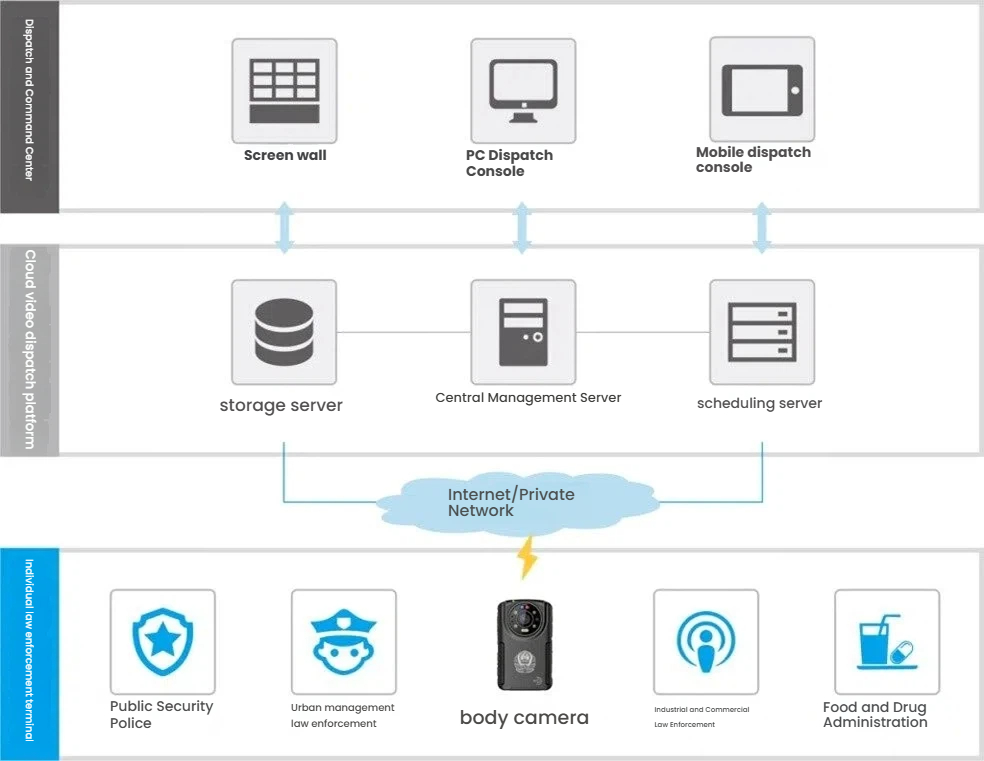
This system is composed of three parts: the front-end subsystem, the underlying network, and the monitoring client.
This system design is a video monitoring system based on 4G wireless transmission. Frontline personnel carry 4G law enforcement recorder terminals, compress and encode the images of emergencies and the case handling sites, and then transmit them to the monitoring platform of the rear command center. This facilitates the command and dispatch work of the rear leaders and relevant personnel.
2.5 Application Benefits
1. Effectively improve the chain of evidence for rights protection
The audio and video data clearly and objectively depicted the execution management scene, serving as powerful evidence to reflect the truth. This effectively solved the problems such as the parties' unreasonable behavior at the scene, their refusal to admit the facts afterwards, malicious defamation and complaints, as well as the difficulties faced by the enforcement personnel in safeguarding their rights and obtaining evidence. It also protected the legitimate rights and interests of the enforcement personnel.
2. Effectively promoting the standardization of execution
3. Effectively enhanced the control over the duty operations
4. Effectively ensured the accuracy of the analysis and judgment
5. Effectively promoted the scientificization of the assessment process
III. Equipment Performance and Technical Specifications
3.1 4G Law Enforcement Video and Audio Recorder
The 4G law enforcement video recorder TQ-1017DSJ-ZF is equipped with a triple protection IP68 design, Android 8.1 operating system, MTK quad-core high-speed processor, dedicated buttons and blind operation design. It supports dual SIM dual standby and is paired with a 3.5-inch high-definition Corning Gorilla Glass screen. The device is compact and easy to carry, capable of achieving functions such as data upload, infrared night vision, law enforcement evidence collection, intelligent recognition, voice communication, video conference, etc. By combining with professional expansion accessories, it can digitally record the dynamic and static on-site situations during law enforcement, facilitating law enforcement personnel to use it in various environments.
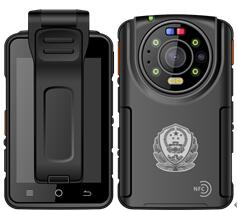
project | functional description | |
essential parameter | operating system | Android 8.1 |
display screen | 3.5 inches | |
CPU | Quad-core, 1.5GHz | |
internal storage | 2GB, storage capacity 16GB | |
TF block | Standard 32GB, up to 128GB | |
Triple camera | The video camera has 4 million effective pixels, the photo camera has 13 million effective pixels, and the front camera has 2 million effective pixels. | |
two-way intercom | Built-in column noise-canceling microphone with 1.5W dual tweeters; IP68 waterproof design for recording and audio output | |
video parameter | video codec | H.264 encoding / H.265 decoding |
infrared parameter | infrared night vision | Facial recognition is available at 3 meters, and facial contours are recognized at 5 meters. |
network | wireless | Supports 4G full network coverage and dual nano SIM cards |
WIFI | 802.11 a/b/g/n, compatible with 2.4G and 5G | |
PDA | Supports Bluetooth headphones for audio calls | |
fixed position | Beidou + GPS positioning | |
other | key | Power button, emphasis key, PTT button, SOS button, photo button, video button, audio button, and custom button |
levels of protection | IP68, free drop test at 2 meters | |
charging mode | Standard 5V/2A charging, with additional support for in-car and contact charging | |
battery capacity | 2700mAh battery, 4000mAh optional, battery replacement without shutdown | |
cruising power | You can replace the battery without power interruption. The local recording time exceeds 8 hours. | |
ambient temperature | Low-temperature battery, operating temperature: -30℃~55℃; room-temperature battery, operating temperature: -10℃~55℃ | |
size | 107mm×63.8mm×17mm | |
weight | 170g (excluding the back clip) | |
3.2 Law Enforcement Recorder Data Collection Workstation TQ-ZCS-1017DSJ
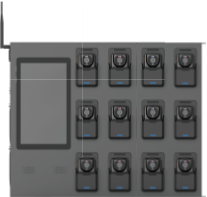
The law enforcement recorder data collection workstation is used in conjunction with the law enforcement recorder as the carrier of the electronic evidence system. It adopts a wall-mounted design, an Intel Core i5 processor, a 13.3-inch high-definition anti-glare touch screen, 8GB of large memory, an innovative cooling system, efficient cooling, quiet operation, a fast on-off experience, and multi-level permission management. The appearance is relatively simple, making it easy for users to operate. It is widely used in law enforcement units such as public security, urban management, customs, procuratorate, and court.
Technical specifications
project | performance specification | |
Hardware specifications | CPU | Intel Core i5 |
Main Display | 13.3-inch FHD 1920*1080 IPS | |
touch screen | 10-point touch, G+F+F, water-resistant, gloves allowed | |
internal storage | 8GB/16GB DDR3L | |
hard disk storage | Supports 23.5-inch hard drives, with 18TB drive as standard, and 1512GB SSD for system and video data caching. | |
WIFI | Supports 802.11 ac/a/b/g/n,2.4G/5G | |
data acquisition port | 1 POGO for data acquisition | |
suona | 2×2W speaker for playback and alarm, 8Ω | |
joggle | Collection station slot | It comes with 6 standard slots and supports 3 expansion docks, each with 6 additional slots, allowing up to 24 body cameras to connect simultaneously. |
USB expansion port | 2 USB 3.0 ports for connecting external fingerprint recognition modules, and 6 USB2.0 ports for interfacing with law enforcement recorders of other specifications. | |
network interface | 10M/100M/1000M network interface | |
Power interface | National standard power cord with three-pin pin-type socket, rated voltage AC100V—240V~50/60HZ (wide voltage) | |
WIFI antenna interface | SMA interface supported antenna | |
HDMI joggle | Supports external high-definition large-screen displays | |
software configuration | operating system | Windows 7/10 64-bit |
software system | TBA | |
other | source | 220V/2A input, 400W ATX power supply |
charging current | A single body camera can handle a maximum charging current of 1.5A. | |
working temperature | Operating temperature: -10℃ to 55℃; Storage temperature: -40℃ to 60℃ | |
ESD | Contact 4kV, air 8kV | |
3.3 Server
Generally, it is recommended that the hardware central server be built within the internal network of the unit. Through the port mapping mode, the local network host can be specified. Through the firewall in the middle, it can be set up within the local network, which can effectively prevent the server from being infected by viruses and from suffering unnecessary attacks.
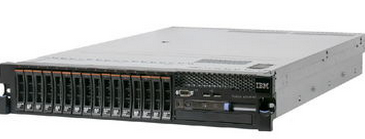
If you need background storage, it is recommended to configure the storage server separately. The configuration of the storage server only needs to ensure sufficient storage space and strong forwarding capabilities. The following configuration is for reference only. The server can basically meet the online usage of 100 terminals. It is best to use a blade-type dedicated server for the server.
CPU type: Intel Xeon E5-2600v3 series and above
CPU frequency: Above 1.8GHz
CPU core: Quad-core or higher.
CPU quantity: 2 or more
Memory: 16G ECC DRR3+ or higher.
Storage: 1T (non-storage server, no requirements)
Power Supply: Redundant Dual Power Supply
Operating system: Windows server 2008 R2 Enterprise SP1。
3.4 Emergency Command and Dispatch System Function
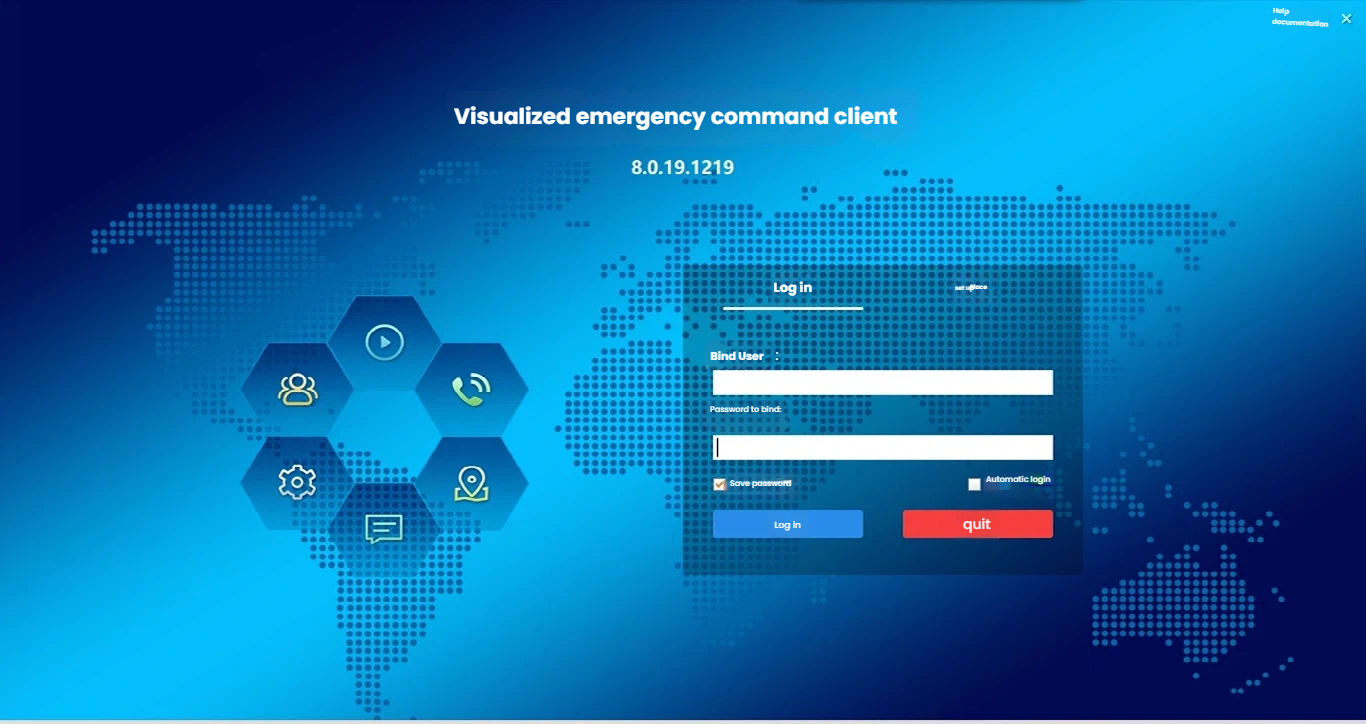
To better meet the needs of the emergency command field, our company has developed a visual emergency command and dispatch platform system. The mobile visual emergency command and dispatch platform system is specifically designed for 4G law enforcement video recording intelligent terminal devices, expanding the access to fixed monitoring terminals to achieve visualized dispatch and command on one map; efficiently and quickly locate the incident; and have real-time and all-round control.
This system consists of terminal equipment at the emergency site and the command center. It can integrate the terminal equipment and the command center organically, thus meeting the diverse needs of customers. It can conduct highly intensive deployment in key areas in real time, achieve real-time two-way audio and video communication remotely, enable mobile front-end group interaction, synchronize command and dispatching, conduct video conferences and transmit and store high-definition videos. It is mainly applied in departments such as railways, public security, armed police, fire services, and emergency response. In emergency and sudden situations, through remote real-time video images, one can observe the on-site situation from multiple angles, facilitating decision-making analysis and unified command. This system can be applied in mobile environments such as emergency command, mobile law enforcement, and sampling and evidence collection, featuring rapid networking, convenient operation, high-definition transmission, two-way interaction, and group discussion.
3.4.1 Real-time scheduling
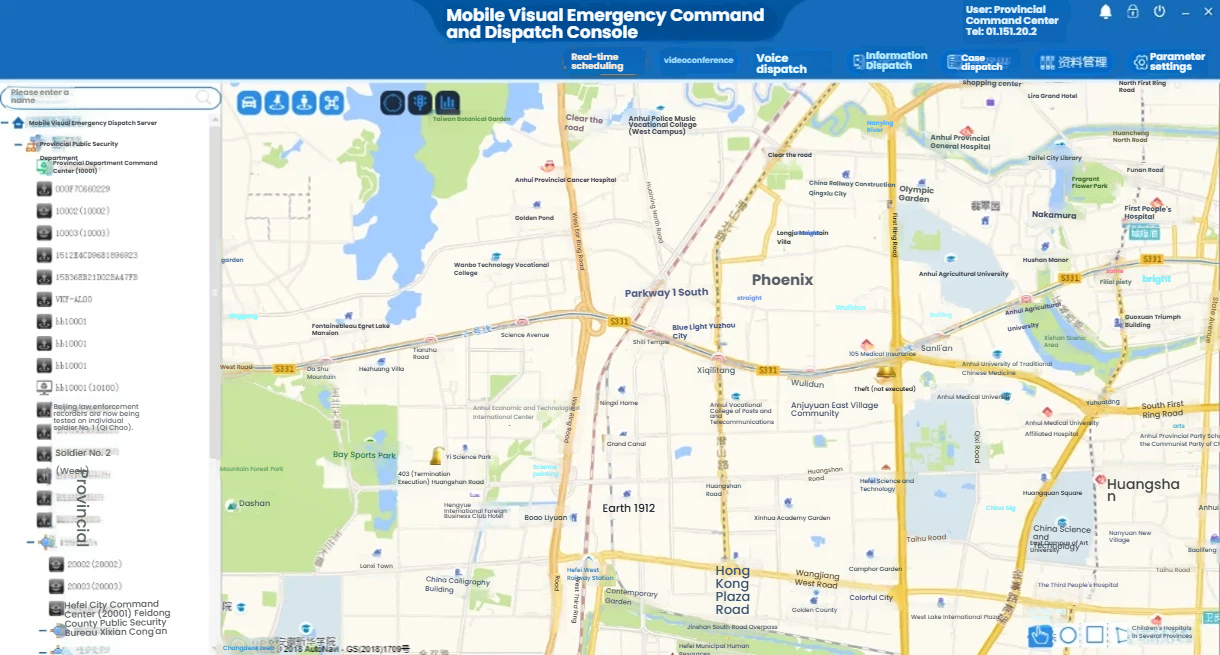
A single image visualization enables the command center to view the real-time location information of law enforcement officers through a chart. They can selectively and conveniently view it based on the filtering function. By selecting and selecting on the map, temporary groups can be created, allowing for message sending, group calls, and one-click playback functions. This way, it provides the command center with more efficient and useful information for dispatching and commanding.
l Dual-screen per device: Achieve efficient visual dispatching. One screen displays the real-time location information of law enforcement officers; one screen displays the real-time images of law enforcement officers; or one screen shows status information, task enforcement situation, deployment of law enforcement officers, etc., all at a glance.
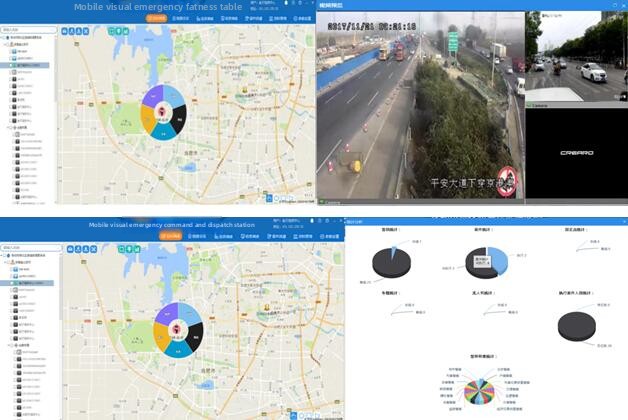
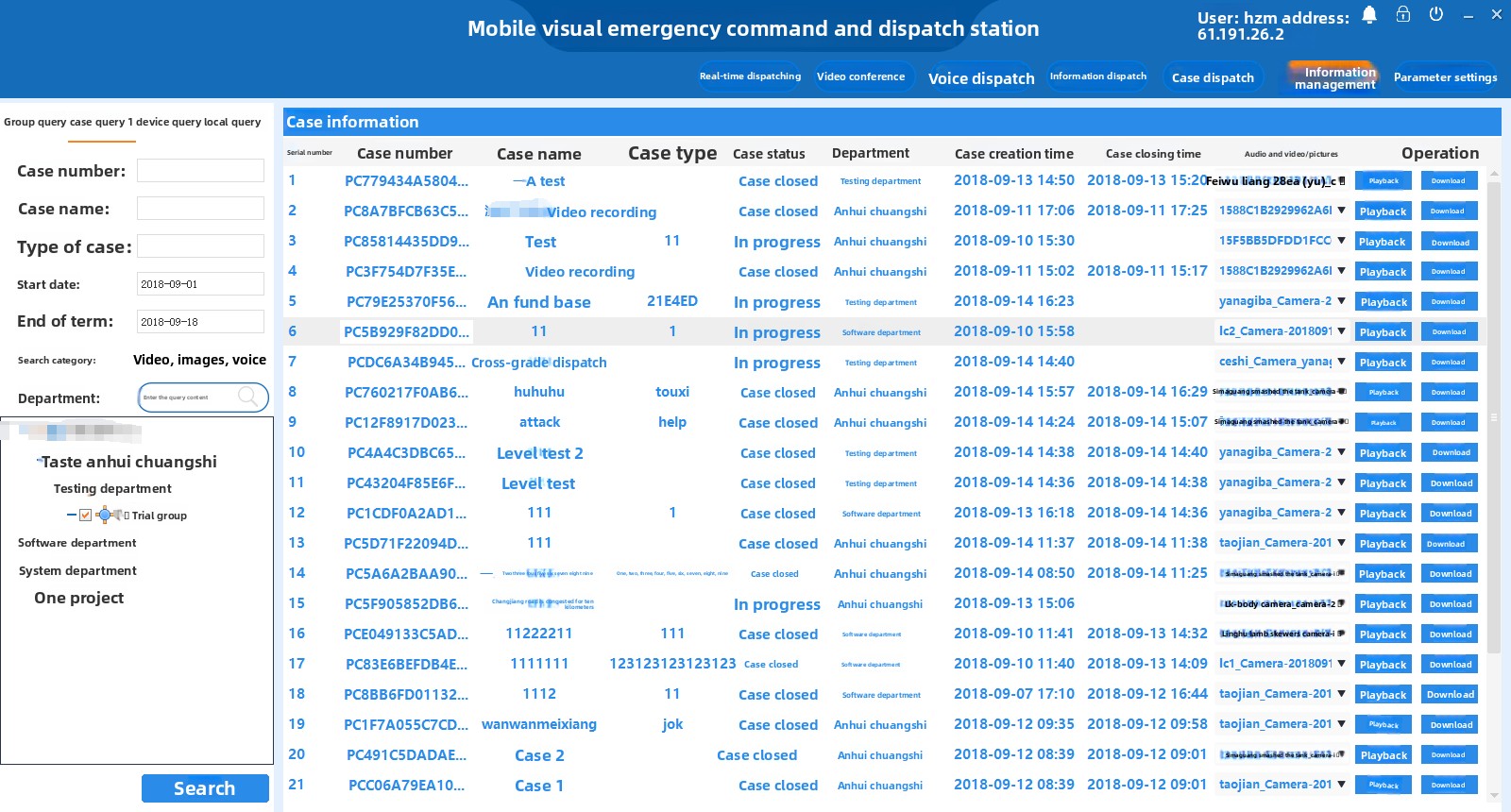
l Case Dispatch: When the command center receives an alarm, the dispatcher can mark the case on the PC client and then send it to the law enforcement recorders of surrounding/ designated officers through the system. After the personnel arrive, the center can also retrieve the video of the officers' case handling and store it. This reduces the levels of information transmission and enables rapid response during command and dispatch.
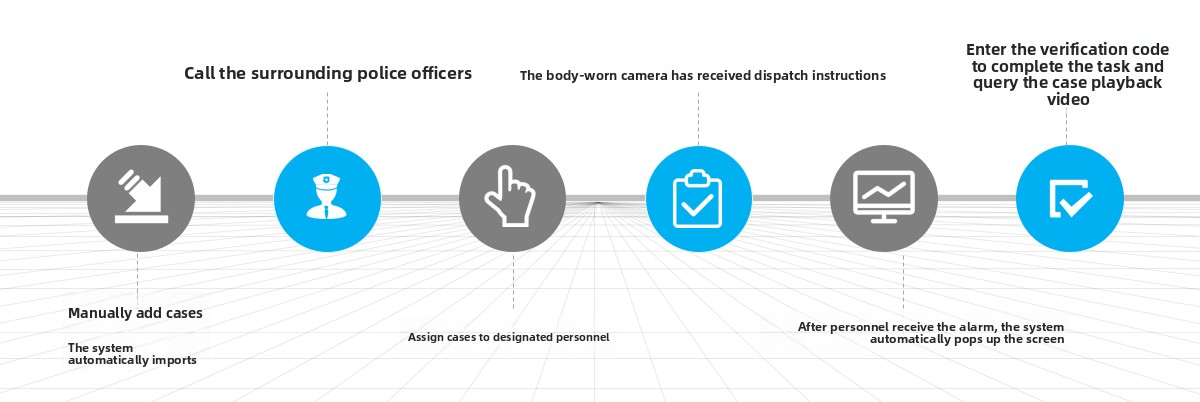
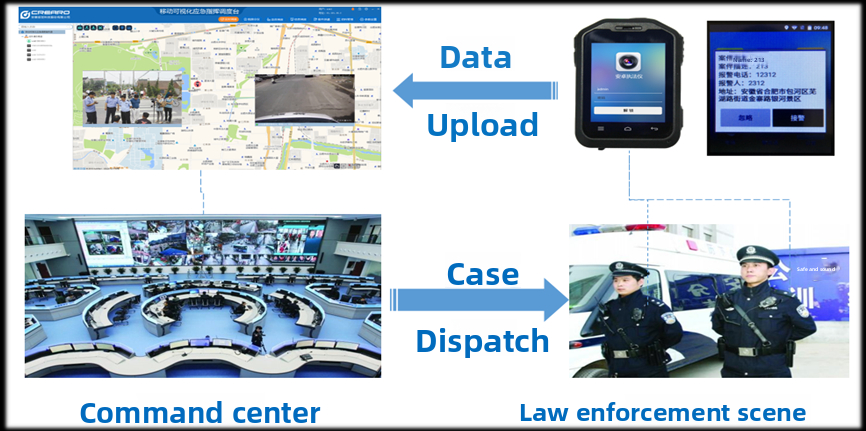
On the case dispatch interface, one can manage cases more efficiently and perform more comprehensive operations for personnel dispatch.
3.4.2 Voice Cluster
Users can make voice calls with other dispatch centers or emergency terminals through the emergency command dispatch system, making the operation of the emergency command system more smooth. It supports group calls, monitoring, cluster calls, one-on-one calls for groups, and enables top-down command issuance; communication and exchanges between peers; as well as bottom-up requests, support, and feedback.
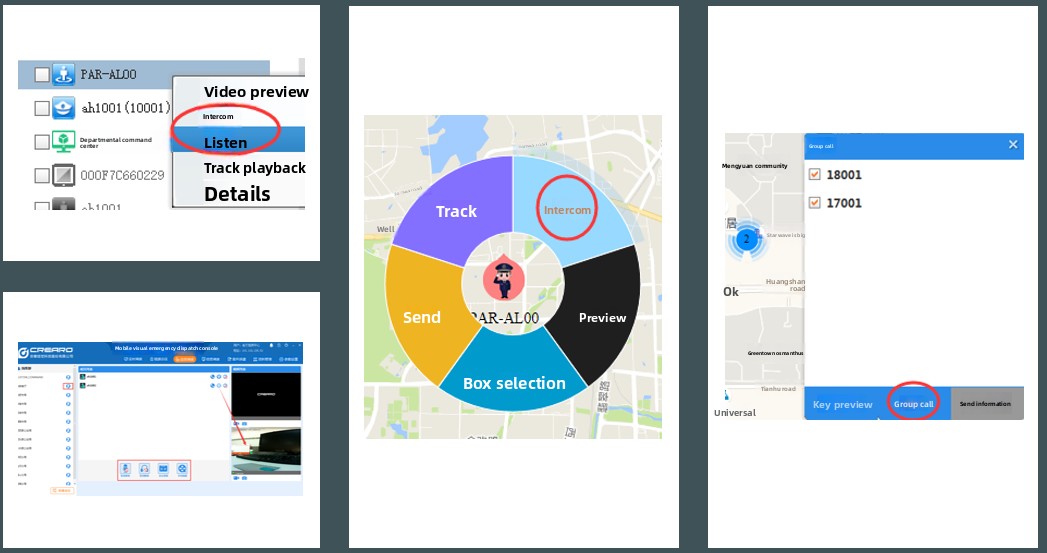
Group call function:
After the dispatch center initiates a group call, each node can take turns to request to speak. Other users in the cluster can hear this user's speech.
Listening function:
The dispatching console can enable other users in the cluster to listen in, and the front-end voice is uploaded to the dispatching console.
Cluster Function:
After the dispatch center initiates the discussion, everyone in the cluster can speak and hear each other, freely engaging in the discussion.
Intercom function:
Between the dispatch consoles or between the dispatch consoles and the equipment, one-to-one voice calls can be made, enabling the voice communication function.
3.4.3 Video conferencing
For certain specific scenarios, the video conference function can be enabled. This mainly involves one terminal device initiating a video call request to another terminal device, or the front-end automatically uploading the bound video stream so that other scheduling platforms can view the real-time video. This facilitates users to better utilize the scheduling and command platform and carry out relevant emergency work. The function supports converting groups into video conferences for video consultation, enabling more realistic and genuine command and dispatch. Through the real-time transmission of on-site images and voice, it provides opportunities for back-end professionals to provide guidance.
3.4.4 Instant message
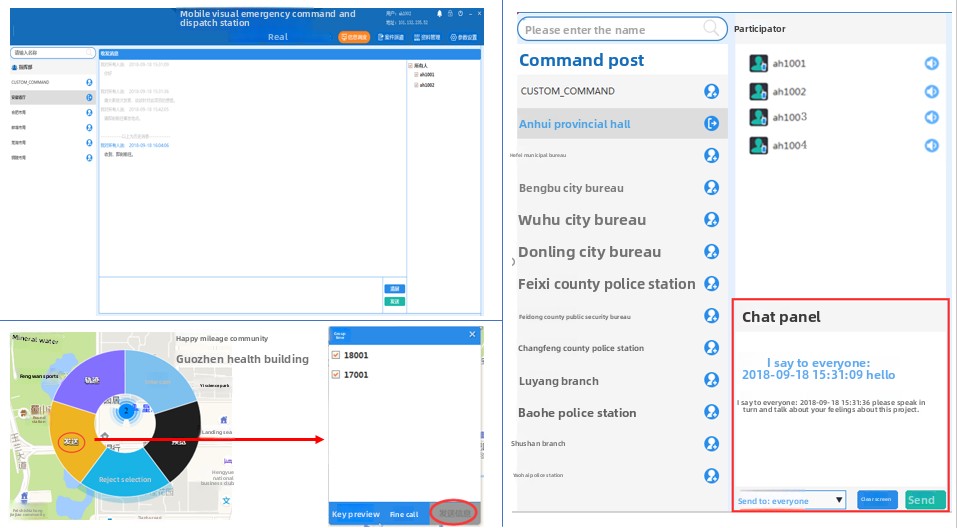
Considering the actual usage scenario, due to data confidentiality or other factors such as network bandwidth, users need to conduct text and image communication between the dispatch console and the front-end equipment. Therefore, our company provides the dispatch console users with real-time message communication function. Users can conduct text, image, emoticon, location annotation and other communication exchanges with a single device in the cluster in a P2P manner, or have extensive text and image communication discussions with all devices in the cluster, thus meeting the users' maximum communication function requirements.
3.4.5 Document presentation / Whiteboard sharing
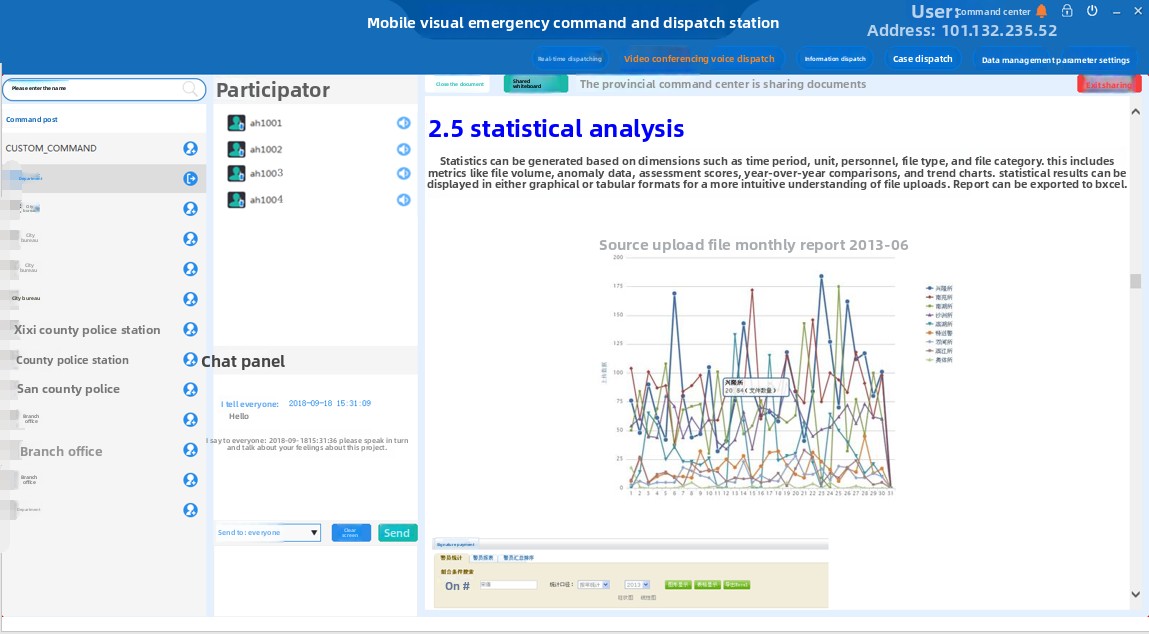
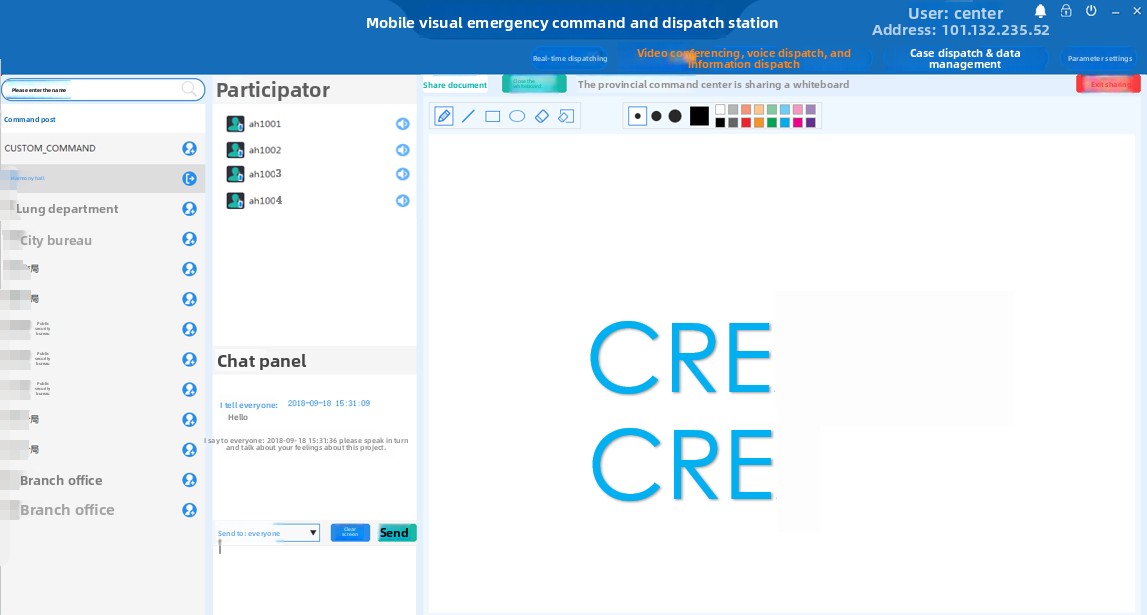
Considering the dissemination of the unit's guiding spirit, work reports, on-the-job training, etc., in video conferences, merely seeing the personnel and hearing the sounds in the venue is not sufficient. Personnel outside the venue cannot see the guiding documents, report materials, and training contents, etc. in written form. Therefore, a document sharing function has been developed in the emergency command and dispatch platform. Usually, the latest guiding documents can be shared, allowing other personnel to directly view them on the dispatch console or front-end equipment. During video conferences, documents can be inserted for real-time guidance explanations or reports, which is more in line with actual work meetings, achieving efficient and high-quality document sharing.
3.4.6 Data management
Historical data management enables targeted and rapid queries and playback for different types of groups, cases, and devices; historical data is linked to cases, facilitating automatic archiving of the data.
Real-time data: Quickly locate the latest information of the current device, and query and download it with just one click.