

What Is an IP Mesh Radio and How Does It Work?
2025-10-24


The physical characteristics of wireless communication determine that the shorter the communication transmission distance, the easier it is to achieve high bandwidth. This is because as the wireless transmission distance increases, various interferences and other factors that cause data loss also increase. Therefore, choosing to transmit data through multiple short hops will be an effective method to obtain higher network bandwidth, and this is precisely the advantage of Mesh networks.
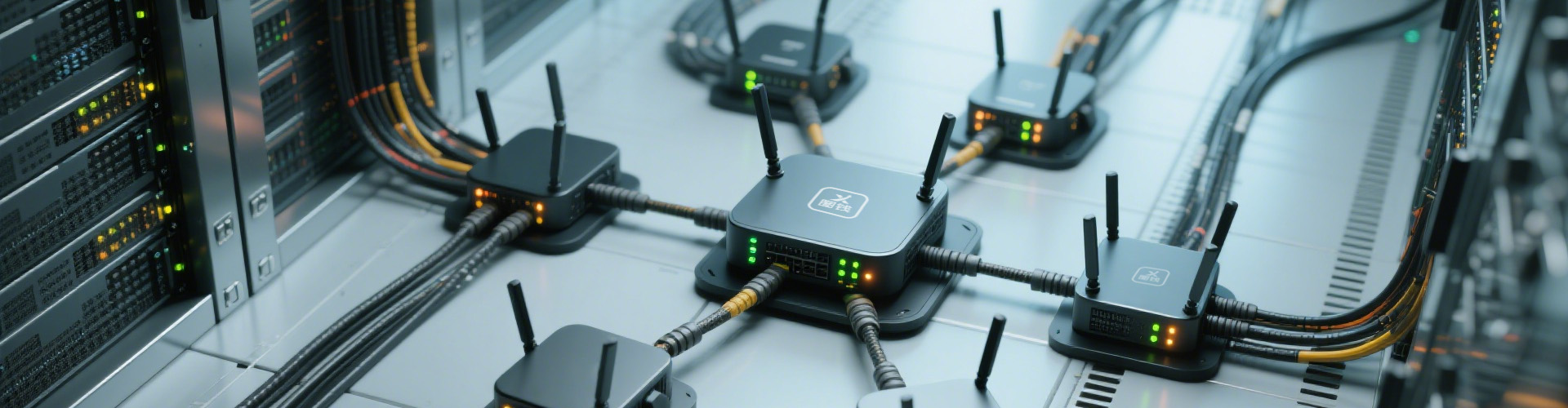
In a Mesh network, a node not only can transmit and receive information, but also can act as a router to forward information to nearby nodes. As more nodes are interconnected and the possible number of paths increases, the total bandwidth also significantly increases. Moreover, since the transmission distance of each short-hop is short, the power required for transmitting data is also smaller. Since multi-hop networks usually use lower power to transmit data to nearby nodes, the wireless signal interference between nodes is also smaller. The channel quality and channel utilization efficiency of the network are greatly improved, thus enabling higher network capacity. For example, in a high-density urban network environment, the Mesh network can reduce the mutual interference among adjacent users using wireless networks, greatly improving the channel utilization efficiency.

The drawbacks of Mesh networks. Although wireless Mesh access technology has a wide range of application prospects, it also has some issues that hinder its widespread deployment.
(1)Interoperability
At present, one of the major obstacles hindering the rapid popularization of wireless Mesh access technology is interoperability. Currently, there is no unified access network technology standard for wireless Mesh networks. Users can either only use the wireless Mesh products of a certain manufacturer or face the problem of how to interface with various different types of embedded wireless devices. This issue is currently the most important reason affecting the promotion and application of wireless Mesh access technology. To completely solve the interoperability problem, ultimately, the industry needs to formulate a unified wireless Mesh access technology standard.
(2)Communication delay
Since data in a Mesh network is forwarded through intermediate nodes for multiple hops, each hop will inevitably cause some delay. As the scale of the wireless Mesh network expands, the more hops there are, the greater the accumulated total delay will be. Some applications with high requirements for communication delay, such as voice or streaming media applications, may face the problem of unacceptable excessively long delays. Currently, the main solution to this problem is to increase the number of Mesh nodes and adopt appropriate network protocols.
(3)Safety
Compared with the single-hop mechanism of WLAN, the multi-hop mechanism of wireless Mesh access technology means that user communication has to pass through more nodes. The more nodes a data communication passes through, the more significant the security issue becomes. The Internet itself is a typical example of using Mesh for communication, and its security risks are well-known. Although various end-to-end security technologies used in wired networks, such as Virtual Private Network (VPN), can also be used to solve the security problems of wireless Mesh, just like the Internet, the security of wireless Mesh networks is a problem that cannot be ignored.
The application of Mesh networks:
Essentially, the Mesh network is a wireless network architecture similar to point-to-point. This architecture can significantly reduce the infrastructure costs of the network (such as the number of APs and wireless routers), and also can reduce the operating and installation costs for wireless network service providers (WISP) by 70% to 75%.
Based on the advantages of the Mesh network, it can also provide various services in different heterogeneous environments. When users are in high-speed movement or within a large area, they can receive voice and data through 3G or 2.5G transmission. Within a local area, broadband network services such as video on demand can be provided through WLAN. With the further development of the Mesh network, it will eventually be able to integrate office phones or mobile phones in the office environment of enterprises. The Mesh network has broad application prospects in many fields such as homes, enterprises and public places.
1.Family
One of the significant applications of Mesh technology is for establishing home wireless networks. The home-style wireless Mesh networking can connect desktop PCs, laptops, handheld computers, HDTVs, DVD players, game consoles, and various other consumer electronic devices without the need for complex wiring and installation processes. In a home Mesh network, various household appliances not only act as users on the network but also serve as components of the network infrastructure to provide access services for other devices. As the number of household appliances increases, this networking method can offer more capacity and a wider coverage area. Another key benefit of Mesh technology in home environments is its ability to support bandwidth-intensive applications, such as high-definition video.
2.Enterprise
Currently, most enterprise wireless communication systems adopt traditional cellular phone-style wireless links to provide point-to-point and point-to-multipoint transmission services to users. However, wireless Mesh networks are different. They allow network users to share bandwidth, eliminating the bottleneck of current single-hop networks and enabling dynamic balance of network load. Adding or adjusting APs in wireless Mesh networks is also easier, more flexible to configure, and has lower installation and usage costs compared to wired APs. Especially for enterprises that need to frequently move access points, the multi-hop structure and flexible configuration of wireless Mesh access technology will be very beneficial for adjusting and upgrading the network topology structure.
3.School
Campus wireless networks are very similar to those of large enterprises, but they also have their own unique characteristics. First, the scale of campus WLANs is huge, not only in terms of geographical coverage and the number of users, but also in terms of communication volume, as students tend to use multimedia more frequently than general enterprise users. Second, the requirement for network coverage is high, and the network must be able to achieve seamless roaming between indoor and outdoor areas, auditoriums, dormitories, libraries, and public places. Third, load balancing is extremely important, as students often gather in groups, and communication congestion may occur when they all use the network at the same location.
The traditional approach to addressing these issues is to install a high density of APs indoors while installing very few outdoors. However, due to the significant fluctuations in user demands on campus networks, it may be necessary to frequently add new APs or adjust their deployment locations, which would lead to a substantial increase in costs. In contrast, using a Mesh networking method not only makes it easy to upgrade and adjust the network structure but also enables seamless roaming between indoor and outdoor areas.
4.Hospital
Mesh also provides an ideal networking solution for public places like hospitals. Due to the dense and complex structure of hospital buildings and the need to prevent electromagnetic radiation in some areas, it is one of the most challenging fields to install wireless networks. Hospital networks have two main characteristics. One is that wiring is relatively difficult: in traditional networking methods, walls and floors need to be drilled to lay cables, which is obviously not conducive to changes in the network topology. The other is that the robustness of the network is highly demanded: if there are important activities in the hospital (such as surgeries), any possible network failure will bring disastrous consequences. Wireless Mesh networking is an ideal solution to these problems. If the topology of the hospital's wireless network needs to be adjusted, it is only necessary to move the positions of the existing Mesh nodes or install new Mesh nodes, which is a very simple process and it is also very convenient to install new Mesh nodes. The robustness and high bandwidth of wireless Mesh access technology also make it more suitable for deployment in hospitals.
5.Tourism and leisure venues
Mesh is highly suitable for use in locations that are geographically remote, have difficult wiring conditions, or are economically unfeasible, yet require providing users with broadband wireless Internet access, such as tourist attractions, resorts, motels, etc. Mesh can offer broadband services to these places at the lowest cost.
6.Quick deployment and temporary installation
For those places that require rapid deployment or temporary installation, such as exhibitions, trade fairs, disaster rescue sites, etc., Mesh networks are undoubtedly the most economical and effective networking method. For instance, if a meeting or exhibition needs to be held for a few days in a certain location, using Mesh technology to set up the network can minimize the cost.