

IP Mesh vs Traditional Wireless Network: What’s the Difference?
2025-10-28


The Internet has transformed the world and accelerated the upgrading of the entire security industry. From traditional analog monitoring to the era of network monitoring, from 720P to 1080P to the upgrading of 4K technology, the Internet has profoundly influenced the security industry. The arrival of 5G means that there will be another major breakthrough in the wireless transmission of video surveillance.
The transition from 4G to 5G transmission technology
From 2G to 3G to 4G and then to 5G, this is the continuous upgrading of transmission methods and transmission speeds. Speed is the ultimate criterion for transmission. Yes, precisely because of the rapidly increasing transmission speed, our lifestyle is being transformed.
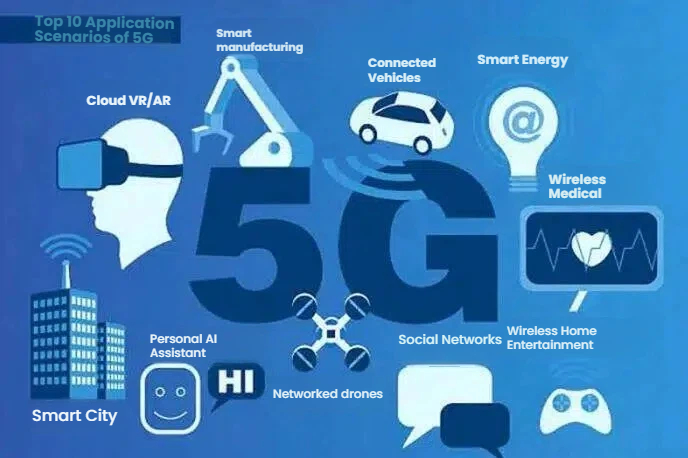
Now let's take a look at several typical 5G scenarios in terms of user experience:
1、speed
5G will be 10 to 100 times faster than 4G. The faster speed will also increase the network capacity, enabling more users to log in to the network simultaneously.
2、Panoramic video: It can also be achieved on mobile devices
Many people will surely be attracted by the huge screens in the stadium. But what if you could get the same real-time images in games or on your smartphones? You could even switch the camera angle and instantly replay the scenes. The high-definition 4K videos will surely impress you.
3、Self-driving cars: Up to 1 million network connections can be established simultaneously within an area of 1 square kilometer.
The current 4G network we are using has an end-to-end latency limit of around 50 milliseconds, and it is still difficult to achieve remote real-time control. However, in the 5G era, the end-to-end latency will only be 1 millisecond, which is sufficient to meet the requirements of intelligent transportation and even autonomous driving. The current 4G network does not support the simultaneous connection of such a large number of devices to the network; it only supports a limited number of mobile phones to access the network. In the 5G era, within 1 square kilometer, there can be as many as 1 million network connections, most of which are various devices that know the road environment, provide driving information, analyze real-time data, and make intelligent predictions about traffic conditions... Through them, drivers can understand the situation of themselves and surrounding vehicles without being affected by weather conditions, and can truly have a 360-degree, no-angle-limit view. In case of danger, they can also receive early warnings in advance, and even achieve autonomous driving.
4、Internet robot: Real-time feedback of doctor's instructions
For doctors, robots will have great potential in surgery. However, they need to provide real-time feedback to the instructions given by the doctors. When executing complex commands, the working robots need to achieve seamless "communication" with the doctors.
5、Virtual Reality: Various sensory experiences require ultra-fast network transmission.
When you put on the VR helmet, you enter a virtual world. In this world, you can interact with others, play games and even high-five. With 5G, the collaboration between users will usher in a new era. Two people in the same physical location will be able to cooperate with each other. Various sensory functions require ultra-fast network transmission to enhance virtual reality. The network is inherently a pipeline.
The new revolution in security protection
With the development of data communication and multimedia service demands, the 4G applications that meet the needs of mobile data, mobile computing and mobile multimedia operations have brought earth-shattering changes to various industries. Especially, the development of mobile internet has provided disruptive changes for users in all industries. Security and protection will also undergo significant changes.
It is well known that in the 4G era, security equipment providers have begun to widely launch wireless monitoring products and technologies that are compatible with 4G networks. However, currently, wireless video surveillance and wired video surveillance are operating in parallel. But the characteristics of wireless video surveillance, such as ease of installation, strong flexibility, and high cost-effectiveness, have begun to be increasingly valued by consumers. However, they are still limited by the limited bandwidth resources, numerous interference factors, and the large volume of video signal data and high real-time requirements. With the rise of 5G networks and the reduction of tariff rates, these problems may all be resolved. The wirelessization of network monitoring will become a new direction.
Entering the 5G era, security is no longer confined to the security industry alone. Wireless technology has brought new changes to the Internet of Things, cloud computing, big data, and artificial intelligence. Cloud solutions will become increasingly popular. Mobile monitoring solutions, intelligent home systems based on mobile internet, etc. will gradually enter people's sight. 5G will completely transform the overall security industry structure in the future.