

IP Mesh vs Traditional Wireless Network: What’s the Difference?
2025-10-28


Wireless video transmission is one of the most crucial technologies for drones. Its performance directly affects the flight distance, the quality of real-time image transmission, and the transmission delay.
Wireless video transmission mainly uses three frequency bands: 1.2GHz, 2.4GHz, and 5.8GHz. Among them, the 2.4GHz band is now very crowded. Wi-Fi (except for 802.11ac), Bluetooth, and wireless mice all operate in this frequency band area. The 1.2GHz band is a regulated frequency band in most parts of the world, while the 5.8GHz band currently has very few interferences. Therefore, nowadays, most unmanned aerial vehicle (UAV) wireless video transmission works in the 2.4GHz band and the 5.8GHz band.
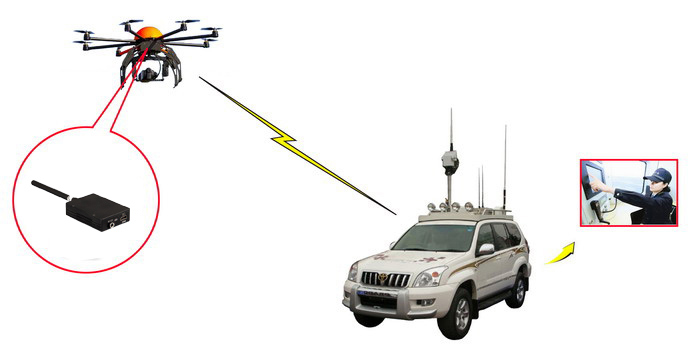
Numerous data indicate that the wireless data transmission performance of the 5.8GHz band is superior to that of the 2.4GHz band. However, in reality, the higher the frequency of the radio waves, the shorter the wavelength, which means they have stronger penetration power but poorer actual diffraction ability. In other words, under the same objective conditions, the 5.8GHz band's video transmission technology has a lower physical blocking transmission capability in space compared to the 2.4GHz band.
When it comes to the wireless video transmission technology of drones, it is inevitable to talk about DJI. Taking the recently released Mavic Air as an example, DJI adopted an enhanced Wi-Fi video transmission technology for it, supporting two frequency bands: 2.4GHz and 5.8GHz. To reduce signal interference, DJI specially placed the antenna under the left rotor on the front side. The official stated that its video transmission technology can achieve a maximum range of 4km with a 720p resolution in the FCC standard mode, and up to 2km in the CE standard mode.
Of course, the W-Fi video transmission technology mentioned here is different from the Xiro Zero Xplorer Mini that I used to play with, the Tello that I recently came into contact with, or even the Spark from DJI, which are all Wi-Fi drones that can be directly controlled via a mobile phone. What I'm referring to here is the technology that enables wireless communication and image transmission between the drone and the remote controller.
The Wi-Fi video transmission technology follows the TCP/IP protocol of ordinary Wi-Fi. The two-way handshake mechanism of the TCP/IP protocol may theoretically cause some delay in Wi-Fi video transmission. Additionally, when the remote controller and the drone lose connection temporarily and then re-pair, the Wi-Fi transmission technology needs to re-handshake and reconnect, which takes a slightly longer time.