

What is meant by lightning protection grade?
2025-11-08
In 2023, people who had been suffering from the coronavirus finally breathed a sigh of relief. With the end of the lockdown policies, although the pandemic had had a considerable impact on businesses, many of them regarded "surviving" as their top goal under the circumstances of the coronavirus. So, after going through this severe test, how should the security industry develop? And what new development opportunities will it encounter?
The year 2020 will undoubtedly be a memorable and special year for China. At the beginning of the year, the outbreak of COVID-19 made the whole country enter a tense period. Besides the round-the-clock protection provided by frontline medical staff, many enterprises also endeavored to contribute their own strength in this battle against the epidemic. For instance, security and AIoT enterprises. Especially after the country called on the effective use of science and technology to assist the battle against the epidemic, these enterprises quickly entered the combat state, leveraging front-end intelligent devices such as artificial intelligence, facial recognition, thermal imagers, AI temperature measurement, and big data analysis capabilities to empower refined epidemic prevention and control through technological means. Well. After the conclusion of this battle against the epidemic, we have entered the post-epidemic era. How will the security industry develop after going through this epidemic? The following analysis may provide some food for thought for the industry.
The role of artificial intelligence in human society is far more than just monetization.
In the post-pandemic era, humans will coexist with the virus. Artificial intelligence and big data technologies are used to track the close contacts of those infected with the virus, making precise epidemic prevention and control a reality. But apart from tracking and tracing, artificial intelligence is also combined with security technologies.
Starting from densely populated places such as railway stations and high-speed railway stations, which are transportation hubs, we can clearly see that thermal imaging temperature measurement devices or AI + thermal imaging temperature measurement (face recognition + thermal imaging temperature measurement) have been rapidly and widely applied in crowded places for precise and safe long-term continuous temperature screening, reducing the risk of cross-infection caused by contact-based temperature measurement. To reduce the error caused by wearing masks on face recognition, many companies have even launched solutions and products for mask-enclosed face recognition, which can perform non-contact and precise identity recognition in scenarios where masks are worn correctly.
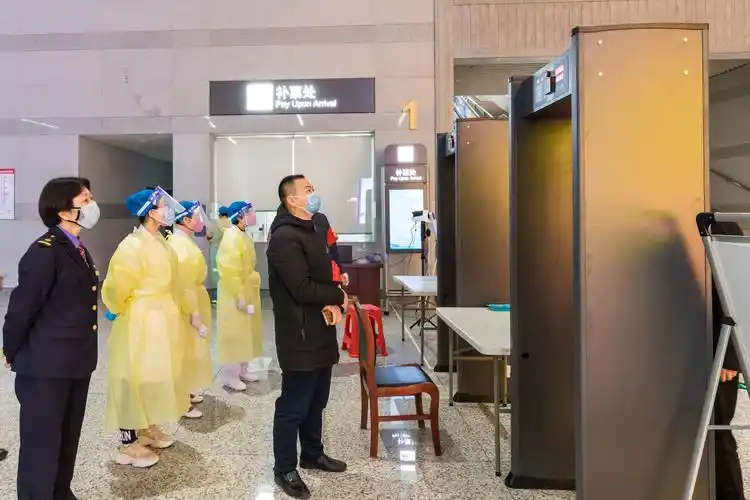
In community access management, artificial intelligence, access control systems, and channel management systems have formed a unique and perfect combination. They conduct individual screenings of the entering and exiting personnel, effectively implementing community epidemic prevention and control. For instance, Rilide's human body temperature measurement solution based on the access control management system and the non-contact wristband access control applied in Huoshenshan Hospital have changed the traditional contact-based access control system, upgrading it to a fully non-contact access and channel management system. This can assist various enterprises and institutions in conducting personnel isolation, identity verification, and temperature screening, reducing the probability of virus transmission.
Of course, in this battle against the epidemic, artificial intelligence and security technologies are not the only heroes. "It is undeniable that 5G technology has also played a significant role in this epidemic fight. Currently, the Wuhan Leishenshan Hospital and Huoshenshan Hospital have completed the coverage of 5G networks. The remote consultation platform built using 5G networks can support medical experts from both places to diagnose patients by sharing their medical records through video." 5G equipment and technologies have increased the promotion of practical applications in epidemic prevention and control. They will develop even more in the post-epidemic era.
In the post-pandemic era, the country has allocated a large amount of funds to major infrastructure projects in an effort to promote economic recovery. A number of new security monitoring projects will be actively launched, and the security market will continue to expand.
This sudden epidemic event has to some extent changed the traditional working mode. Mobile/remote work has become a demand for many users. The security industry, as one of the first beneficiaries of artificial intelligence technology, has relatively mature mobile/remote working technologies. For instance, mobile visitor systems, mobile access control systems, and non-contact parking systems, all apply Internet technology to achieve access control purposes. And after this epidemic event, the mobile/remote working in the security industry is bound to experience rapid development.
All of the above points ultimately boil down to a vision. "Any security system should undergo self-improvement and should possess the ability for emergency management. Emergency management is not a business direction; rather, it is a functional upgrade of the enterprise's product system. For instance, access control and passage control systems should reach the level of epidemic prevention, providing more configurable functions to the client units to cope with emergencies."
However, we also need to clearly recognize that the macroeconomic downturn is an uncontrollable external environment. Under the context of the Sino-US trade war, it has actually brought many opportunities to domestic security enterprises. The impact of cross-border giants will cause industry pressure, but at the same time it also boosts the industry's activity. In this situation of crisis and opportunity, private security enterprises should better cultivate their internal capabilities. They should transform from a rough and hasty business model to a "precise, specialized, and lightweight" model. "Precise" means having a flat and detailed management system that can form a cohesive combat team; "Specialized" means specializing in products and services, increasing R&D investment, and reaching the advanced technical level of the industry; "Light" means simplifying the lengthy processes in the company's entire business chain and creating a response mechanism that can quickly adapt to the market.
The security industry is evolving rapidly, with new technologies constantly emerging, which can bring new business opportunities at any time. Looking ahead, the security industry is bound to undergo transformation towards large-scale, automated and intelligent operations.