

What is meant by lightning protection grade?
2025-11-08


• 5G backhaul is not just fiber optic; wireless backhaul is regarded as a future-oriented backhaul technology.
• Deutsche Telekom and Ericsson have collaborated to achieve a 100Gbps backhaul rate on a 1.5-kilometer E-band (70/80GHz) microwave link for the first time. This is 10 times the current commercial microwave backhaul rate.
• Deutsche Telekom stated that this is a major technological breakthrough of milestone significance.
Wireless Deployment Site Diagram:
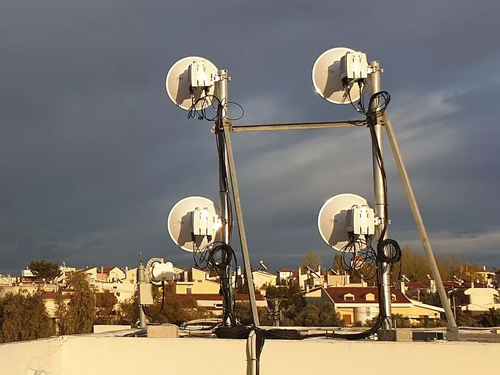
The detailed introduction is as follows:
1. The E-band microwave enters the 5G era
According to statistics, approximately 40% of macro base stations worldwide use microwave backhaul. The main technology employed is traditional microwave (in the 6-42GHz frequency band), with an average backhaul capacity ranging from 50Mbps to 500Mbps. This is insufficient to meet the backhaul capacity requirements of base stations in the 5G era.
If 40% of the macro base stations worldwide were to undergo fiber-optic backhaul upgrades, the cost would be unimaginably high. Therefore, in the 5G era, we need microwave communication with higher transmission capacity.
For this reason, the E-band microwave entered the historical stage.
E-Band microwave refers to the microwave frequency band located around 80 GHz. The actually allocated frequency band consists of two symmetrical segments: 71-76 GHz and 81-86 GHz, with a total available bandwidth of up to 10 GHz.
The bandwidth of traditional microwave channels ranges from 3.5 MHz to 112 MHz. The channel bandwidth of the E band can reach up to 1000 MHz to 2000 MHz. After adopting advanced modulation methods, multi-band aggregation and MIMO technologies, it can meet the backhaul requirements of 10-20 Gbps for 5G era base stations.
2. First to exceed 40 Gbps
The 10-20 Gbps microwave backhaul capacity can meet the needs of early 5G deployments and some rural area base stations. However, as 5G progresses, the traffic demand is constantly increasing, and the industry is calling for higher microwave backhaul capacity.
At the end of 2018, Ericsson and Deutsche Telekom achieved a breakthrough in wireless backhaul rate of 40 Gbps on a 2000 MHz channel bandwidth using the commercially available equipment MINI-LINK 6352, which was 4 times faster than the existing systems.
3. A landmark breakthrough of 100 Gbps
The 40Gbps microwave backhaul rate is still insufficient. Looking to the future, the peak rate of 5G will reach 10-20Gbps, and the backhaul capacity of base stations will also increase accordingly. The demand for traffic will never cease, and the industry is calling for even higher microwave backhaul capacity.
Today, the microwave backhaul capacity has once again achieved a breakthrough - reaching 100 Gbps.
According to the information on the official website of Deutsche Telekom, this time the equipment still uses Ericsson's MINI-LINK 6352, but it incorporates technologies such as 8x8 line-of-sight MIMO and cross-polarization interference cancellation. On the 2.5GHz channel bandwidth, it has achieved simultaneous transmission of 8 data streams, thus achieving a transmission rate breakthrough of 100Gbps.
Deutsche Telekom stated that during the trial period in mid-April, the measured transmission rate was consistently above 100 Gbps, the transmission reliability was consistently above 99.995%, and the peak rate could reach up to 140 Gbps.
Alex Jinsung Choi, Senior Vice President of Innovation at Deutsche Telekom, stated that in the 5G era, more advanced backhaul solutions are needed to support high data throughput and enhance customer experience. This trial milestone has conclusively demonstrated the feasibility of microwave backhaul for 5G's high-capacity and high-performance transmission.
Furthermore, this also means that in the future, 5G fiber-based backhaul will witness a new disruptor - 100Gbps wireless backhaul.