

The Application of IP Mesh Radio in Military and Unmanned Aerial Vehicle (UAV) Communications
2025-10-28


Elevators, as the important enclosed public areas and key access routes within buildings, play a crucial role in the security work of the entire area. Video surveillance of elevators is an indispensable part that is indispensable for ensuring the safety of passengers. Elevator video surveillance can provide real-time information about the conditions inside the elevator car, thereby safeguarding passenger safety.
The transmission of elevator monitoring videos can be divided into two types: wired and wireless. The wired transmission uses professional elevator running cables. The general running cables have significant loss when in use and have a lifespan of between half a year and one year. The cables for high-rise elevators have higher requirements for tensile strength and electrical parameters to prevent the cable from stretching and deforming under its own weight, which could cause impedance mismatch and interference in the video signal. Replacing the new running cables is difficult, the construction period is long, and the cost of replacing the running cables is also high. The other type is wireless transmission. Wireless transmission adopts a point-to-point method. A transmitting point is installed on the elevator car and a receiving point is installed at the elevator shaft end. The data can be freely transmitted during the elevator car's movement. The wireless transmission equipment is simple to install and has a lifespan of at least three years. The bandwidth is fully capable of meeting the requirements for high-definition monitoring video transmission.
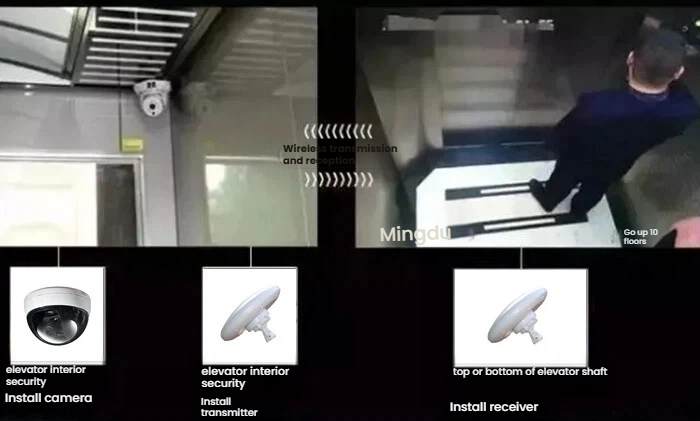
How to deploy:
There are two installation methods for wireless transmission of elevator shaft surveillance videos. The top-mounted type and the bottom-mounted type, as shown in the following picture:
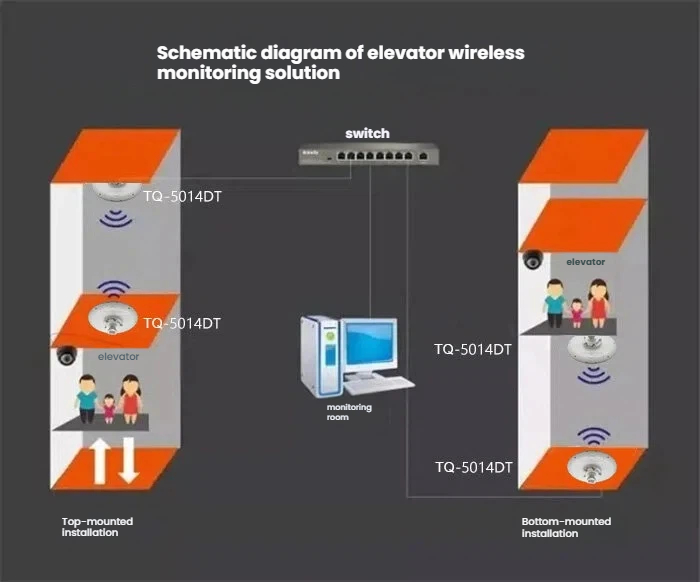
Top-mounted deployment is suitable for the monitoring center located on the top of the building. In most cases, bottom-mounted deployment is adopted.
How to set up a bridge:
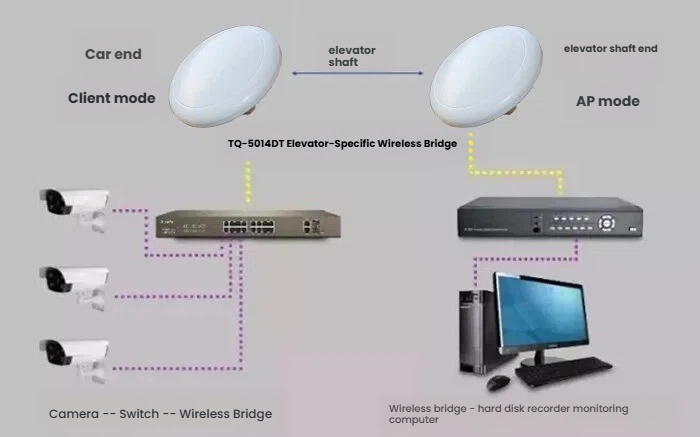
The bridge at the elevator car end should be set to the client (Station) mode. In this mode, the bridge acts like a network card. It converts the video data from the network camera from electrical signals to wireless signals. At the elevator shaft end, the bridge is set to the AP mode. In this mode, the bridge is directly connected to the NVR via a network cable, and the received wireless signals are directly converted into wired signals and transmitted to the NVR.
In summary, the bridge close to the camera end should be set to client mode, while the bridge close to the NVR end should be set to AP mode. Before installing it in the elevator shaft, the bridges need to be paired beforehand.
Installation of wiring and debugging:
The wiring process is relatively simple. All that needs to be done is to connect the cameras and the elevator car network bridge, the elevator shaft network bridge, and the NVR, as well as provide power supply. Since PoE power supply is involved, it is strongly recommended to use network cables of Cat5e or higher specifications here.
There are generally no strong interference signals in the elevator shaft. In case of interference, the signal can be avoided by adjusting the channel. Directly choosing 5G bridge transmission is also becoming increasingly popular.
Our company has newly launched the economic type elevator-specific wireless bridge TQ-5014DT. The product integrates an 802.11n wireless with a maximum output power of up to 28dBm, and is securely placed within a sleekly designed casing. The powerful hardware, equipped with a 14dBi directional antenna, is an ideal choice for medium to short distance scenarios. It supports the 802.11a/n protocol, with a theoretical air rate of up to 300M. The point-to-point transmission has an actual measured bandwidth of nearly 100Mbps. This device operates in the 5G frequency band, with abundant channel resources, excellent spectral efficiency, strong anti-interference capability, and advanced priority control, perfectly supporting the transmission of audio, video and network data. The product design and testing of TQ-5014DT meet the IP-65 protection level. Vibration, temperature and humidity, salt spray and surge impact all comply with industrial standards, ensuring outstanding reliability and maintaining a leading position in the industry. It is highly suitable for special environments such as elevators. Welcome to call for consultation!