

What Is an IP Mesh Radio and How Does It Work?
2025-10-24

The layout of wireless monitoring will vary depending on the specific environment of the client. The correct construction plan will not only enhance the stability of the monitoring system, but also improve the construction efficiency and reduce costs. Below are several schemes for digital monitoring in terms of data transmission.
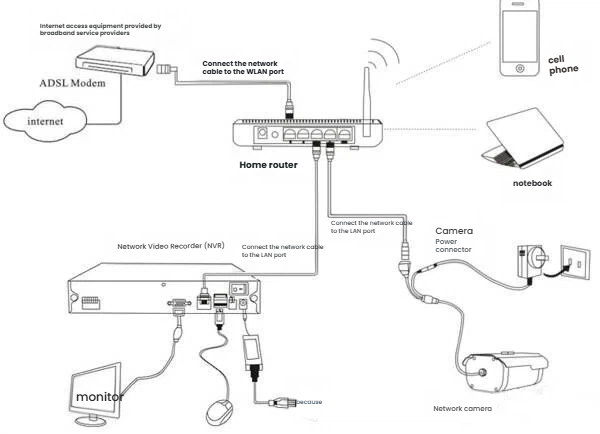
First, the classic setup: one camera, one power source, one network cable.
Cabling: Power cables, network cables. The power cables use standard 220V alternating current for transmission, and one set of power supplies one camera. The network cables are used for data transmission of the video recorder. Both are indispensable.
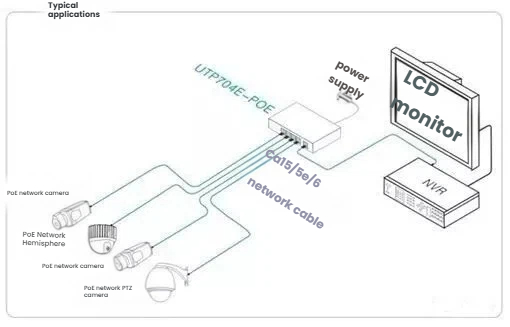
Second, by using POE switches, each camera only requires one network cable and no power cable is needed.
Using an 8-core network cable as the transmission medium, the network cable has its own PoE power supply function. The transmission distance can reach up to 160 meters. It is claimed in the industry that by adopting non-standard mode, the transmission distance can reach 250 meters.
Third, fiber optic + transceiver, enabling longer transmission distances!
When the transmission distance of the monitoring system exceeds 100 meters, generally, network cables will be ineffective. At this point, it is usually necessary to consider using optical fibers. The transmission distance of optical fibers can reach up to 20 kilometers!
Fiber optics use light to transmit data and require an optical transceiver to complete the task. Optical transceivers are used in pairs to convert optical signals into electrical signals and vice versa. As shown in the following figure:
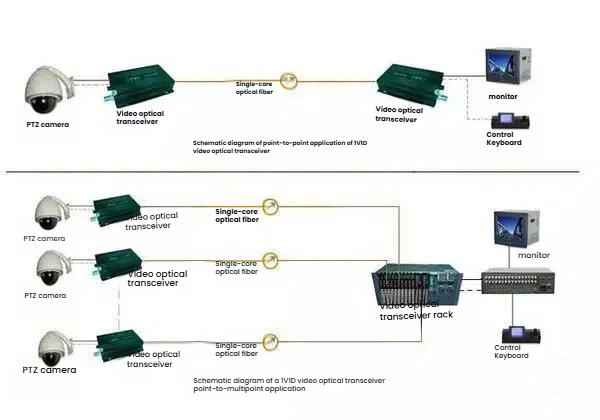
Fiber optic transceivers are available in both 100 Mbps and 1000 Mbps versions, and the type can be selected based on the number of cameras you have.
Optical fibers are inexpensive and have a long transmission distance, and are widely used in monitoring projects. However, optical fibers require splicing, and the splicing equipment is expensive. Therefore, generally, splicing needs to be done by professionals, which incurs certain costs and takes some time. This has deterred many engineering companies!
Of course, for pigtail optical fibers, cold splicing can also be performed. The cold splicing tools are relatively inexpensive. Even so, these cold splicing tools are not available to every engineering company, especially for those friends who rarely use optical fibers.
Fourth, wireless bridge, wireless transmission of surveillance videos
In some construction environments, using wired methods has become difficult. For instance, in residential areas where the roads have already been paved, in elevators, in factories that have already been built, in open areas that are far apart, in the wild, and so on. In these environments, using wired methods presents significant challenges. At such times, wireless bridge technology can come in handy.
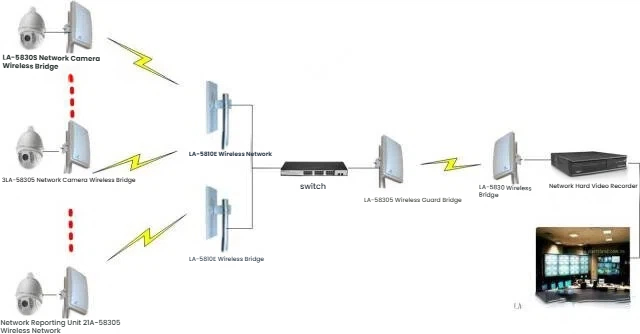
Wireless bridge can convert network signals into radio waves for point-to-point transmission. It is used in pairs. Due to the point-to-point directional transmission, it can achieve long-distance wireless transmission ranging from several hundred meters to several tens of kilometers.
With a wireless bridge, the only requirement is that there should be no obstruction between the transmitting and receiving ends. There must be no barriers, otherwise the signal transmission will not be stable.
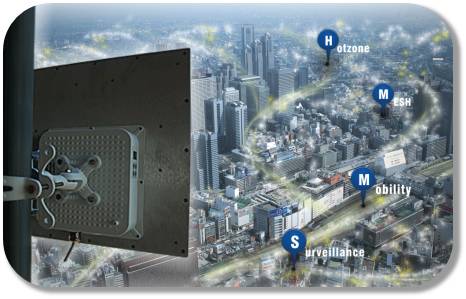
Wireless bridges can be classified into two types based on their working frequency: 2.4G and 5.8G.
2.4G has a lower price and is widely used. The rate of 2.4G wireless bridges is generally 150M, and the bandwidth is relatively small, making it suitable for transmitting a small number of monitoring signals. Since the civilian WIFI signals are also 2.4G, in some environments, they may interfere with the signals of the wireless bridge. However, there is no problem when used at close range.
The 5.8G frequency band is relatively clean, with a transmission rate typically above 300M. It is suitable for long-distance and large-scale wireless transmission for monitoring purposes.