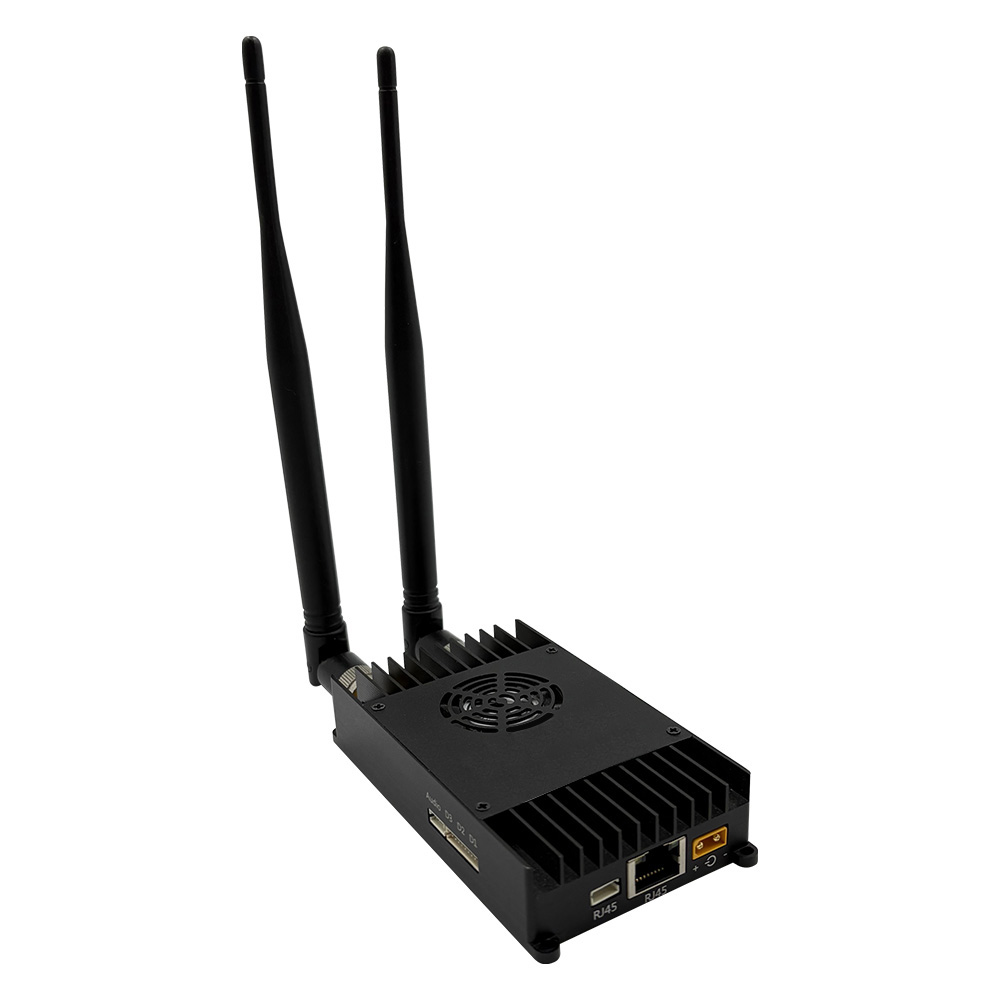


What Is an IP Mesh Radio and How Does It Work?
2025-10-24


Some time ago, people learned two key parameters in the selection of network switches for monitors: backplane bandwidth and packet forwarding rate.

Many friends sent private messages directly saying:
How should I choose the access switch when using a wireless bridge for transmission?
And was it me who used a wireless bridge with a bandwidth of several megabits to transmit the remote web-end surveillance cameras?
To put it more simply, how many surveillance cameras can a 200M wireless bridge actually transmit?
Regarding this problem, I have consulted several different manufacturers and also collected some materials from the internet. Today, I'd like to share my findings with all of you.
Whether it is monitoring of wireless bridge transmission or copper cable transmission, the monitoring devices and the application systems are the same. They are all divided into three layers: the core layer, the aggregation layer and the connection layer.
We have mentioned the selection parameters for the high-definition monitoring system switch several times before.
In fact, we can consider the wireless bridge as a switch with built-in access and upload ports. For example, two wireless bridges with a range of 1.5KM and a transmission capacity of 200M can be regarded as a 200M 'dumb' network switch. It's just that the transmission method has changed from the original copper cable to wireless network.
Since it is a dumb switch, we will calculate based on the main parameters such as connection and transmission of a 200M network switch.
Let's start by discussing the bandwidth consumed by the compression transmission of a single camera:
The server bandwidth occupied by surveillance cameras can be measured by video bit rate or bitrate. The common specifications and recommended video bit rate values for surveillance cameras are listed in the table. This table follows the reduction method of H.264 (about 40% reduction) and H.265 (also about 40% reduction). For detailed information, please refer to: I have a little understanding of H.264, but I'm not very clear about it. H.265 is overwhelming! ; Simple and clear, H.264 vs H.265 solid-state drive calculation method!
During the operation process, the bitrate of the monitoring cameras is adjustable. Moreover, due to the differences in the natural environment, the video bitrate will automatically change: for instance, when the interface monitor is in a relatively clean or static data interface condition during the bright daytime, the video bitrate is relatively lower; while at night, with lower light intensity and increased interface noise, the video bitrate without response will increase significantly. In our actual operation, we usually design it as a variable bitrate to achieve a better monitoring effect. However, reducing the bitrate will definitely come at the cost of sacrificing image quality or frame rate.
Having talked about how the reduction of surveillance cameras leads to a decrease in network bandwidth usage, let's now delve into the specific method for calculating the number of load monitoring cameras:
Theoretical value: Number of cameras = Wireless bridge transmission bandwidth (200M) / Camera transmission rate
That is: 200M/8M (200-megapixel camera) = 25.
You must be surprised: Wow, so many!
But why can't we achieve such an effect in practice? The delays are often very long and the system is prone to freezing. What's going on here?
Hurry up and brush up on it! Review the previous articles: A detailed discussion on some basic knowledge of wireless bridges; How to troubleshoot problems with wireless bridges and wireless monitoring devices? ; Do you know about these common purchase mistakes related to wireless bridges?
After reading all this, I have gained a general understanding and application of wireless bridges. I believe that in terms of point-to-point communication, the transmission characteristics of the same bridge will decrease as the transmission distance increases. Moreover, in some cases, relaying or multiple connections to a single point may also be involved.
Another point is that the transmission bandwidth claimed by each manufacturer for the wireless bridge refers to the maximum rate at which the bridge can transmit data between devices under the test distance. The rate can vary significantly depending on the testing environment.
The main difference between wireless bridges and wired transmission is that wireless transmission is more susceptible to external factors such as the environment. Therefore, in engineering, a considerable amount of margin needs to be reserved. You know this, right? Wireless bridge products are highly vulnerable to environmental hazards such as rain attenuation, northern smog, and external temperature. Thus, the selection of the installation environment and functional testing level for wireless bridges is particularly crucial.
In long-distance outdoor transmission, 5G bridges are increasingly favored due to their high transmission bandwidth and strong anti-interference capability, and have gradually become the mainstream. For reference: What are the differences between 2.4G and 5.8G wireless bridges; Some applications of 5.8G wireless bridges.
Sure. Two wireless bridges can handle a certain number of surveillance cameras. Then, based on the backplane bandwidth and packet forwarding rate of the network switch, the aggregation switch for people can be deployed.
In practice, we can easily plan the deployment of monitoring points and wired networks. Today, we also learned a simple algorithm and precautions for the number of cameras in wireless bridges. I think as a way of transmitting network signals, if people consider the following 3 points when using wireless bridges: choosing a surveillance camera that occupies network bandwidth (1.3 million, 2 million, 3 million); relay distance (500 meters, 1,000 meters, 2,000 meters, 3,000 meters); bridge characteristics (brand name, service), then a complete and sound wireless monitoring system can be designed and conceived.
Regarding the deployment challenges associated with the integration of wireless networks with wealth management, the next issue will conduct data statistical analysis using specific engineering procedures.