

What Is an IP Mesh Radio and How Does It Work?
2025-10-24


If you find that the newly purchased 2.4GHz or 5.8GHz device does not provide the wireless coverage capability you expected, it doesn't necessarily mean that there is something wrong with the device or that the placement of the device is incorrect. Over 90% of the reasons are that you haven't equipped the device with the appropriate antenna. Even if your WIFI client can access the internet through the wireless router in your home, have you checked the actual wireless signal strength? If the signal-to-noise ratio (SNR) is too low, the wireless transmission speed cannot reach 54Mbps or a higher speed. Of course, wireless interference can also affect the transmission speed. But if you can't even get a basic wireless signal, don't expect to have a high-speed internet connection. So, which type of antenna should we choose? This cannot be explained in just a few words. Choosing the appropriate antenna is actually a science. We must start by understanding the basic knowledge of antennas. The following article will introduce the principles of antennas and some antenna parameters. I believe it can assist you in choosing and installing the appropriate antenna, thereby enhancing the effective coverage and performance of the wireless system.
An antenna is an unpowered device, meaning it does not require power supply or other energy sources. It is not a power amplifier either, and it does not amplify the input radio signal. Instead, due to the signal attenuation caused by the feeder and connectors, the emitted radio energy will be less than the energy input to the antenna connection point. In fact, the antenna merely plays the role of a directional amplifier, concentrating the transmitting and receiving energy in a specific area of space. The sole purpose of the antenna is to change the energy distribution area to the desired location. If the energy is distributed to areas without wireless devices or excessively distributed to a certain area, it is a waste. According to the law of energy conservation, increasing the energy in one direction means reducing the energy in other areas.
Tone-up
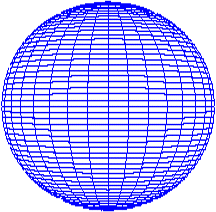
Gain is a general representation method for antenna characteristics. It refers to the intensity gain in a certain area compared to the following two ideal standard transmission-reception modes. The first ideal standard transmission-reception mode is to emit the energy of the radiation body from an isotropic antenna (as shown in the figure), which is an equally directional radiation body, radiating in all directions in space, and all directions have 0 dB. The gain calculated based on this standard is in dBi units, and the other ideal standard transmission-reception mode is based on the energy radiated by a free-space half-wavelength dipole as the reference. The calculated gain is in dBd units. It is obvious that the radiation body of the latter is already higher than that of the former, and the calculated value is 2.16, that is, 1 dBd = 2.16 dBi. Currently, most antennas use dBi as the calculation unit. The typical gain of 2.4GHz or 5.8GHz ranges from 2 dBi to 26 dBi.
Radiation pattern
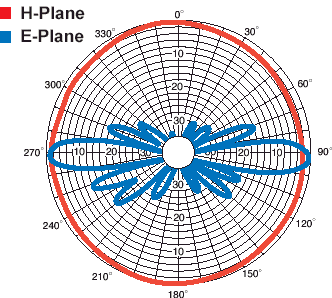
Gain can only serve as a reference for selecting the antenna. It can only show the gain in the direction with the strongest energy, and does not provide any information about the energy distribution. The radiation pattern can precisely display the distribution of energy in free space. The commonly used ones are the horizontal radiation pattern (horizontal / azimuth sweep plane) and the vertical radiation pattern (vertical / elevation sweep plane). The figure on the right shows the horizontal and vertical radiation patterns of the 8dB omnidirectional gain antenna OP2408 produced by a certain company. The red line (H plane) represents the horizontal distribution. Imagine looking at the signal coverage from the top of the antenna, you will find that the energy of the 8dB omnidirectional gain antenna is distributed around the 360-degree area centered on the antenna; the blue line (E plane) represents the vertical distribution. Imagine looking at the signal coverage from the side of the antenna, the energy is only distributed in the same horizontal plane, and the signal will not radiate to the sky or the ground.
Half-power beamwidth
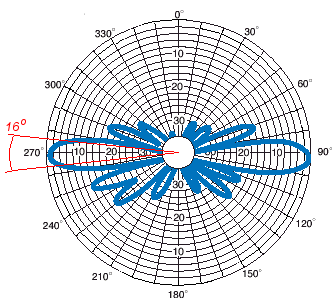
Since not all users can understand the radiation direction graph, it is customary to use another simplified and effective parameter to describe the distribution of energy. This parameter is called "half-power beamwidth" (3dB Beamwidth or half power Beamwidth), or simply "beamwidth". The calculation method is the width between the two emission directions where half of the maximum power is located. We usually refer to this radiation as "main lobe". The beamwidth can be divided into horizontal and vertical types. The figure on the right shows the vertical beamwidth calculated based on the above figure, and the displayed angle is 16 degrees.
增益及波瓣宽度成反比,水平波瓣宽度与垂直波瓣宽度之积越低,天线增益越高,下表为典型天线波瓣的最大增益值。
The gain is inversely proportional to the beamwidth. The product of the horizontal beamwidth and the vertical beamwidth is lower, the antenna gain is higher. The table below shows the maximum gain values of typical antenna beams.
"Side lobes", "Back lobes" and "Front/Back Ratio (F/B)" are another set of parameters for the antenna. Side/back radiation lobes refer to the less intense radiation beyond the main electric wave, and their effect is to waste energy.
The energy is transferred to the sides/backside and interferes with other nearby receiving devices. The energy from other surrounding transmitting devices may cause the received signals to be introduced into the system through back radiation, thereby becoming an interference.
"Front-back ratio" refers to the difference in power between the radio wave's apex and a point 180° away from it. In typical cases, this difference ranges from 25 to 45 dB. A higher "front-back ratio" can reduce interference to the coverage area of adjacent cells.
Antenna polarization
"Antenna polarization" refers to the direction of the electric field vector in the radiated wave. "Linear polarization" refers to the energy portion in a certain plane (vertical, horizontal or at a 45° angle relative to the Earth), while "circular polarization" is a circular rotation (LHCP on the left side, RHCP on the right side). To eliminate the loss caused by polarization mismatch, the receiving antenna must have the same polarization direction as the received radio signal.
Voltage standing wave ratio
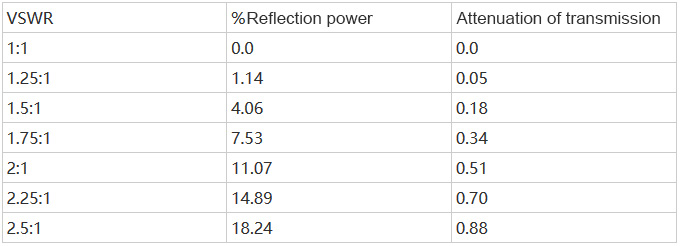
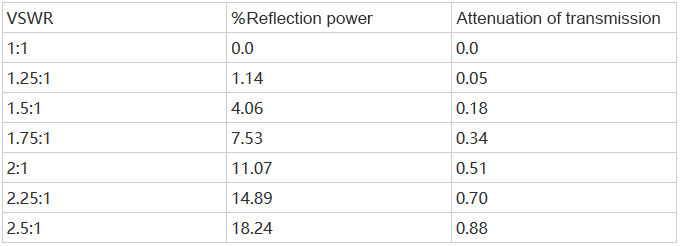
The "voltage standing wave ratio" (VSWR) of an antenna is the ratio of reflected power to input power. It is mainly influenced by the matching degree between the input impedance at the antenna connection terminal and the characteristic impedance of the transmission line. The higher the matching, the finer the reflection wave and incident wave ratios will be, and the reflected wave will reduce the energy transmitted to the antenna, thereby reducing the effective gain of the antenna. The ideal ratio is 1:1, meaning that the input impedance is equal to the characteristic impedance of the transmission line. However, this cannot be achieved. Typically, it is 1.5:1 (with 96% power transmission). The following table shows the relationship between "voltage standing wave ratio" and reflected power.
Antennas can be classified into three main types based on their usage: omnidirectional antennas that emit the main radiation in a horizontal direction, downward-pointing omnidirectional antennas, and directional antennas. An omnidirectional antenna refers to one that radiates in the same shape over a 360-degree horizontal range. We must select the appropriate antenna according to the environmental needs to enable the maximum number of wireless devices to conduct wireless data transmission at the required signal strength. In a large wireless network, choosing the appropriate antenna and installation method not only improves the overall coverage performance but also reduces the number of APs to lower costs.
A omnidirectional antenna that emits in a horizontal plane of the main lobe
It can be connected to wireless devices or APs. If the AP and such omnidirectional antennas are installed at a high position, such as on a 30-meter-tall outdoor lamp post, since the radiation shape of the antenna is similar to a bubble, the signal mostly radiates in the horizontal direction, thereby increasing the radiation distance. However, a blind spot will occur below the antenna. Therefore, the antennas of both the transmitter and receiver need to be at the same level.
Inside the warehouse, if the floor height is within ten meters, such omnidirectional antennas can also be used. Although some of the upward energy is wasted, the main energy is horizontally radiated, so the coverage area will be larger than that of other antennas. Below the antenna, although it may not be within the waveband width, since it is not far from the antenna, the less energy of the secondary lobes can already provide good signal coverage.
Full-wave antenna with the main radiation pattern pointing downward
The radiation shape is approximately that of a hemisphere. The signal is emitted both outward and downward. Only a small amount of energy is emitted upward, allowing the wireless signal to be uniformly radiated and transmitted within the coverage area. It is most suitable for installation in some areas above 20 meters, such as for wireless devices that need to consider the same level and the ground. Such antennas are very ideal.
This type of antenna has a narrower horizontal coverage area compared to the omnidirectional antenna that distributes energy horizontally. However, the latter can only cover devices at the same horizontal level.
In some warehouses located within ten meters of the ground floor, it is not recommended to use such antennas. Because there is an excessive amount of energy being released near the antenna, resulting in waste. We should instead use omnidirectional antennas that distribute the energy horizontally, and try to radiate the energy in the horizontal direction as much as possible to increase the coverage area.
Directive antenna
The radiation energy is emitted only in a specific direction of the antenna. There are different gain levels, horizontal beamwidths and vertical beamwidths to choose from. It is suitable for environments where wireless devices are all in a certain direction of the AP, and is also commonly used in point-to-point and one-to-many wireless systems.
MIMO Antenna
MIMO antennas are mainly used in conjunction with 802.11n devices. Each transceiver component is equipped with more than one antenna (currently up to three), to enhance the reception signal and increase the transmission speed. Based on multi-path reflection, a signal emitted from one point can reach a receiving point with multiple antennas. Different antennas may receive direct signals and reflected signals with varying intensities and polarities. The wireless component can select the best signal from them. Currently, MIMO antennas other than the "omnidirectional antenna with horizontal radiation of the main lobe" are all installed with three antennas in the same component. In the directional antenna, one of the three antennas has a 90-degree different polarity from the other two.