

What Is an IP Mesh Radio and How Does It Work?
2025-10-24

Solution 1: Use elevator-specific network cables
Due to the unique circumstances of installing surveillance equipment in the elevator, the elevator needs to move up and down continuously. Therefore, if a wired transmission method is adopted, elevator-specific anti-tension network cables must be used instead of ordinary network cables. Over time, if ordinary network cables are used, they are prone to being pulled apart, thereby affecting the signal transmission.
The elevator-specific network cables can be divided into two types. One type consists of twisted pair + two-core power cable + steel wire (as shown in Figure 1), and the other type consists of twisted pair + steel wire (as shown in Figure 2). The common feature of both types of cables is that they enhance the tensile strength of the cables through the steel wire. The differences lie in that one type contains a power cable and the other does not. If a network camera that does not support POE power supply is used, the first type of cable can be chosen. If a network camera that supports POE power supply is used, the second type can be selected.
Option 2: Utilize wireless bridge transmission method
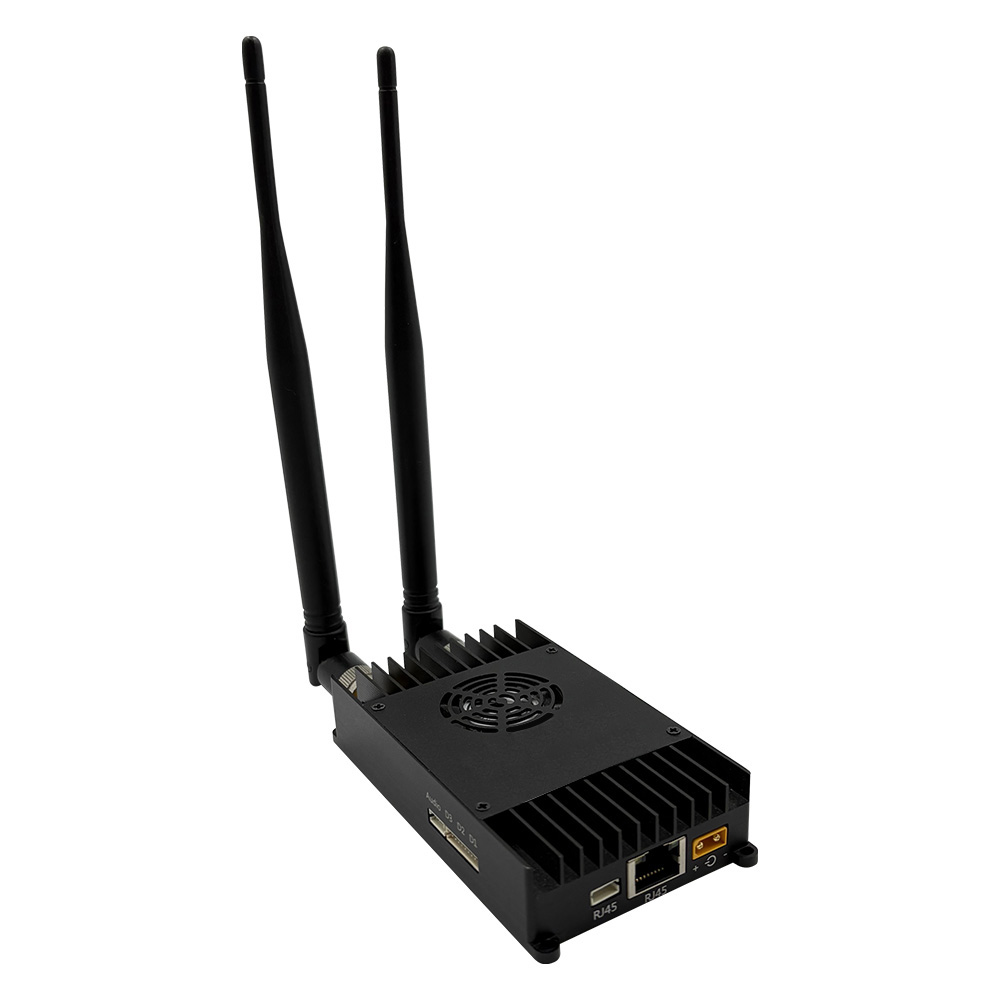
The maximum transmission distance of the network cable is 100 meters. If the building is on a higher floor, a wireless transmission method can also be adopted. The transmitting end of the wireless bridge is fixed on the top of the elevator car, and the receiving end of the wireless bridge is fixed on the top of the elevator shaft. The power supply for the camera can directly use the AC 220V voltage on the top of the elevator car to convert to DC 12V. When using the wireless bridge for transmission, it is necessary to ensure sufficient signal strength of the wireless bridge during equipment debugging to guarantee the smooth transmission of the video signal.
The elevator monitoring system is subject to environmental constraints and thus has strict requirements for signal transmission. Currently, most elevators use AC variable frequency speed control technology, and the variable frequency speed controller itself has strong high-frequency parasitic interference. Usually, the variable frequency speed controller emits interference signals with a bandwidth of 0 to 10 MHz and a strong amplitude, which can enter the video monitoring system through power lines and space radiation, thereby interfering with the video images. Therefore, special multi-shield elevator monitoring dedicated run cables are mostly adopted. Although the construction and raw material costs of the run cables are slightly higher, according to the relevant regulations and construction standards of building intelligence, video run cables are still used. Wireless technology, although the construction is simple, its anti-interference ability and service life are far inferior to cables, and the failure rate is higher. Therefore, when using wireless equipment, a 5.8G wireless bridge must be selected, and a 2.4G wireless bridge cannot be used.
Remark
The 5.8G wireless bridge has higher anti-interference capability compared to the 2.4G one, and the rain attenuation is also smaller. Therefore, it is suitable for long-distance wireless transmission.
The 2.4G wireless bridge has better penetration and diffraction properties compared to the 5.8G one. It is more suitable for indoor WIFI coverage and short-range transmission.
The transmission frequency bands used by the two are different. One is 2.4G and the other is 5.8G. 2.4G was developed earlier, so its signals can be detected in many places, which easily leads to co-channel interference.
Option 3: Utilize Powerline Adapter for transmission.
Network cameras can also be installed in elevators using powerline adapters. Video data can be transmitted through the 220V sockets on the elevator car. A powerline adapter is a "power line communication modem" that enables network transmission via power lines. Power lines are essential cables in elevators. By utilizing the existing power lines and socket components within the elevator for local networks, real-time high-definition video signals can be transmitted, eliminating the need for huge cable installation costs and saving a lot of manpower and resources. It also has the advantage of plug-and-play functionality, making it very convenient to use.
This approach is actually quite good, but if not used properly, it may cause some problems:
For example, when the elevator starts to operate, the video images may experience lag and become unresponsive, making it impossible to watch. Similarly, when viewing the recorded footage through the NVR, there might also be a lag issue.
So when using powerline adapters, there are several points to keep in mind:
1、Under the same electricity meter.
2、The distance between power lines should not exceed 300 meters.
3、The power lines that the Powerline Adapter passes through must not have significant current fluctuations, as they are for use with devices.