

What Is an IP Mesh Radio and How Does It Work?
2025-10-24


Today, traditional fixed cameras can hardly meet the security needs of large-scale scenarios. More and more businesses are using PTZ surveillance cameras to achieve wide-range, long-distance, and flexible monitoring. In environments like construction sites, factory parks, or farms where cabling is difficult, wireless bridges become an important transmission solution to connect remote devices to the monitoring center.
This article introduces the core functions of PTZ surveillance cameras, the role of wireless bridges, and how they work together in basic surveillance systems — in plain language.
A PTZ (Pan-Tilt-Zoom) camera can rotate horizontally, tilt vertically, and perform optical zoom, breaking the viewing-angle limits of fixed cameras. This provides broader coverage and more flexible viewing for large areas.
2. Core Capabilities of PTZ Surveillance Cameras
Feature | Description |
360° horizontal rotation | Nearly full coverage with minimal blind spots |
Optical zoom | Capture distant targets clearly |
Auto cruise | Patrol preset paths automatically |
Smart tracking | Auto-detect and follow moving objects |
Night vision | Continuous monitoring in low-light or dark conditions |
Remote control | Real-time operation via mobile phone or PC |
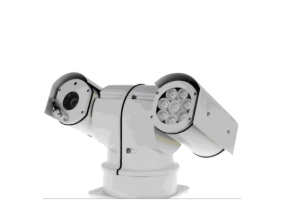
These features are widely implemented in real products. For example, the TQWIF TQ-CZ100GR series smart PTZ surveillance camera features a high-strength aluminum alloy body, IP67 rating, 4K ultra HD output (8K optional for high-end models), and compatibility with mainstream protocols such as Hikvision and ONVIF — ideal for pairing with wireless bridges.
In practice, cameras are often installed far from the monitoring center — for example, on construction site perimeters, parking lot entrances, factory warehouses, or farms. Traditional cabling is expensive and impractical in complex terrain.
A wireless bridge creates a stable wireless link between two points, allowing the PTZ surveillance camera to operate reliably over distance, similar to a wired connection. It solves distance limitations and wiring difficulties effectively.
One PTZ surveillance camera can cover a large area through rotation and zoom, reducing the need for multiple fixed cameras.
Optical zoom captures license plates, personnel activities, and equipment status — delivering more detail than typical fixed cameras.
Wireless bridges eliminate cable constraints. Cameras can be mounted on poles, walls, or remote buildings for greater deployment flexibility.
No trenching or complex cabling is required. Installation cycles are shorter, suitable for temporary or fast-start projects.
Factory & industrial parks — perimeter monitoring, vehicle management, night security
Construction sites — real-time progress viewing and worker safety monitoring
Farms & ranches — large-area monitoring of fences and livestock zones
Parking lots — vehicle entry/exit monitoring and long-range license plate recognition
To ensure system-level stability, TQWIF provides both individual devices and complete wireless monitoring solutions. Key strengths include:
Professional R&D and manufacturing for engineering and complex scenarios
Reliable operation in harsh environments — extreme temperatures, humidity, vibration
Complete wireless communication solutions: bridges, link design, system integration
Multiple certifications: ISO9001, CE, RoHS, etc.
For detailed specifications or solution information, refer to official documentation or contact the TQWIF technical team for support.
The combination of a PTZ surveillance camera and a wireless bridge effectively addresses two key challenges in long-distance monitoring: clear imaging and stable transmission. With proper configuration, a reliable surveillance system can be built without complex cabling work.
Q1: What is the difference between a PTZ surveillance camera and a regular camera?
A1: A PTZ surveillance camera supports remote pan, tilt, and zoom, while a regular camera has a fixed viewing angle and covers only one direction.
Q2: What is the typical effective distance of a wireless bridge?
A2: In line-of-sight, low-interference environments, wireless bridges can support long-distance transmission. Actual performance depends on device quality and environmental conditions.
Q3: Does a PTZ surveillance camera require an internet connection?
A3: Remote viewing and control typically require network access. Local recording can operate without internet.
Q4: What is the most important factor for stable wireless monitoring?
A4: Network stability is primary, followed by installation location and reliable power supply.
Q5: Why does video lag occur in wireless surveillance?
A5: Common causes include insufficient bandwidth, signal interference, high bitrate settings, or unstable wireless links.